
Key to Saving on Summer Air Conditioner Electricity Bills Lies in 'Outdoor Unit Operating Time'... Saving Tips for Inverter and Constant-Speed Models
Since mid-July, a heat wave with daytime highs exceeding 35 degrees Celsius has persisted, significantly increasing the number of households running their air c
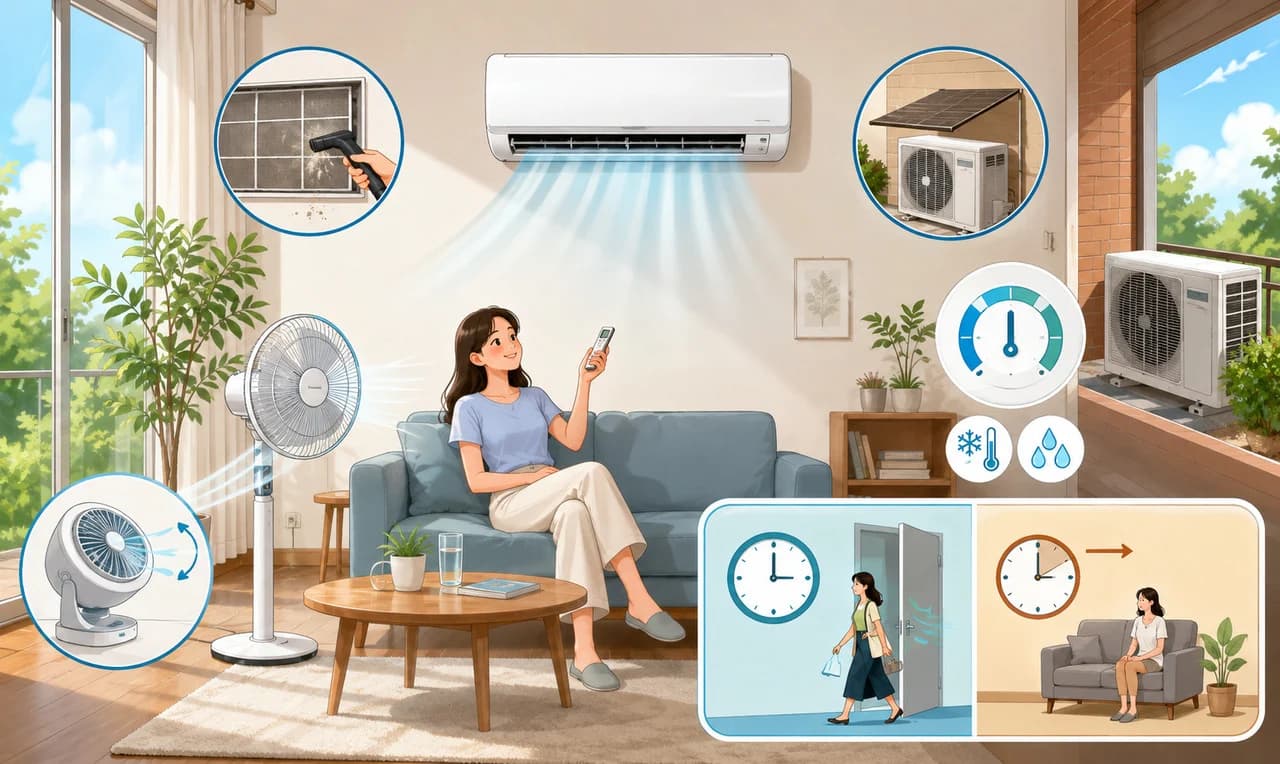
Since mid-July, a heat wave with daytime highs exceeding 35 degrees Celsius has persisted, significantly increasing the number of households running their air conditioners all day. However, the concern remains the electricity bill. Experts point out that the key factor determining air conditioner electricity costs is not the cooling method itself, but 'how long the outdoor unit operates.'
Outdoor Unit Compressor Is the Core of Power Consumption
Most of an air conditioner's power consumption occurs in the compressor inside the outdoor unit. Unlike the ventilation mode, which simply blows air, the moment the compressor starts operating, power usage surges. Therefore, the key to saving energy lies in reducing the compressor's operating time.
Check Whether Your Air Conditioner Is an Inverter or Constant-Speed Model
First, it is necessary to check whether your air conditioner is an inverter or a constant-speed model. The vast majority of residential air conditioners released since 2011 use the inverter method. If the product label separately lists the rated, intermediate, and minimum power consumption, it is an inverter model; if only one value is listed, it can be classified as a constant-speed model. If the energy efficiency rating is between 1 and 3, it is highly likely to be an inverter model. For exact confirmation, you can look up the model name on the manufacturer's website.
Cool Quickly with Strong Airflow, Then Maintain at 26–27 Degrees
In terms of operation, it is most efficient to rapidly lower the indoor temperature with strong airflow at the beginning, and then maintain it at 26–27 degrees with a weak or automatic breeze. Starting with a weak setting from the beginning will actually cause the outdoor unit to operate longer, increasing power consumption. Using a fan or circulator at the same time can lower the perceived temperature by about 2–3 degrees, allowing you to feel sufficiently cool even with the temperature set at 26–27 degrees. According to the Korea Energy Agency, power consumption decreases by about 7% for every 1-degree increase in the set temperature.
On/Off Strategies Vary Depending on the Duration of Your Outing
Whether to turn off the air conditioner for a short outing is also a dilemma. Since inverter air conditioners switch to minimum output once they reach the target temperature, the initial driving power consumed when turning it back on after shutting it off may be higher. Therefore, for short outings of less than one hour, it is more advantageous in terms of electricity bills to leave it on. On the other hand, when leaving for a long period of three hours or more, it is rational to turn it off. Constant-speed air conditioners do not have a significant initial power burden even when repeatedly turned on and off, so turning them off when going out is the basic principle.
Dehumidification Mode Is Not Necessarily Cheaper
Caution is also needed for dehumidification mode, which is frequently selected during the rainy season. The principle of operating the outdoor unit compressor in dehumidification mode is the same as in cooling mode, so it cannot be conclusively stated that electricity bills will unconditionally be lower than with cooling. Unless the indoor humidity is extremely high, it is difficult to consider dehumidification mode to be significantly cheaper than cooling.
Filter Cleaning and Outdoor Unit Environment Are Also Keys to Saving
When dust accumulates on the filter, airflow is blocked, and the outdoor unit must operate longer to achieve the same cooling effect. The Korea Energy Agency stated that power consumption can increase by up to 3–5% when the filter is dirty. Dusting off the filter every 2–4 weeks, removing objects that block ventilation around the outdoor unit, and installing a sunshade if it is exposed to direct sunlight all help improve efficiency. However, the louver windows in apartment outdoor unit rooms must be kept open during operation; if left closed, there is not only a risk of fire, but overheating can also significantly increase power consumption.
Ultimately, there is a consensus that saving on air conditioner electricity bills depends more on lifestyle habits that reduce outdoor unit operating time than on any special technology. However, even for inverter models, leaving the unit on continuously when going out for more than three hours can actually increase electricity bills, so it is necessary to use judgment and turn off the power when going out, tailored to the duration of your absence.
[This article provides general usage information, and actual savings may vary depending on appliance specifications and living conditions. It is safe to check the exact power consumption and whether the unit is an inverter model through the product label or manufacturer information. This is an AI-assisted article.]
CBC Globe publishes verified stories with editorial review, source checks, and tenant-specific publication standards.
Related Articles
Cashback Even With Just 1% Electricity Reduction... Additional 500 Won per kWh for Summer Peak-Time Savings

Multi-Child Highway Toll Discount... 20% for 3 Children Starting July 28, 10% for 2 Children Starting August 22 - Benefits and Application Guide

Suyeong-gu, Busan to Provide 300,000 Won in Living Stability Support Funds to Low-Income Single-Parent Households for Chuseok