
Sell-Side Circuit Breakers Triggered in Tandem as KOSPI and KOSDAQ Plunge... U.S. Semiconductor Shock, China's Pursuit, and Iran Uncertainty Form 'Triple Threat'
The sharp decline in U.S. semiconductor stocks and concerns over China's pursuit of the semiconductor industry have dealt a heavy blow to the domestic stock mar
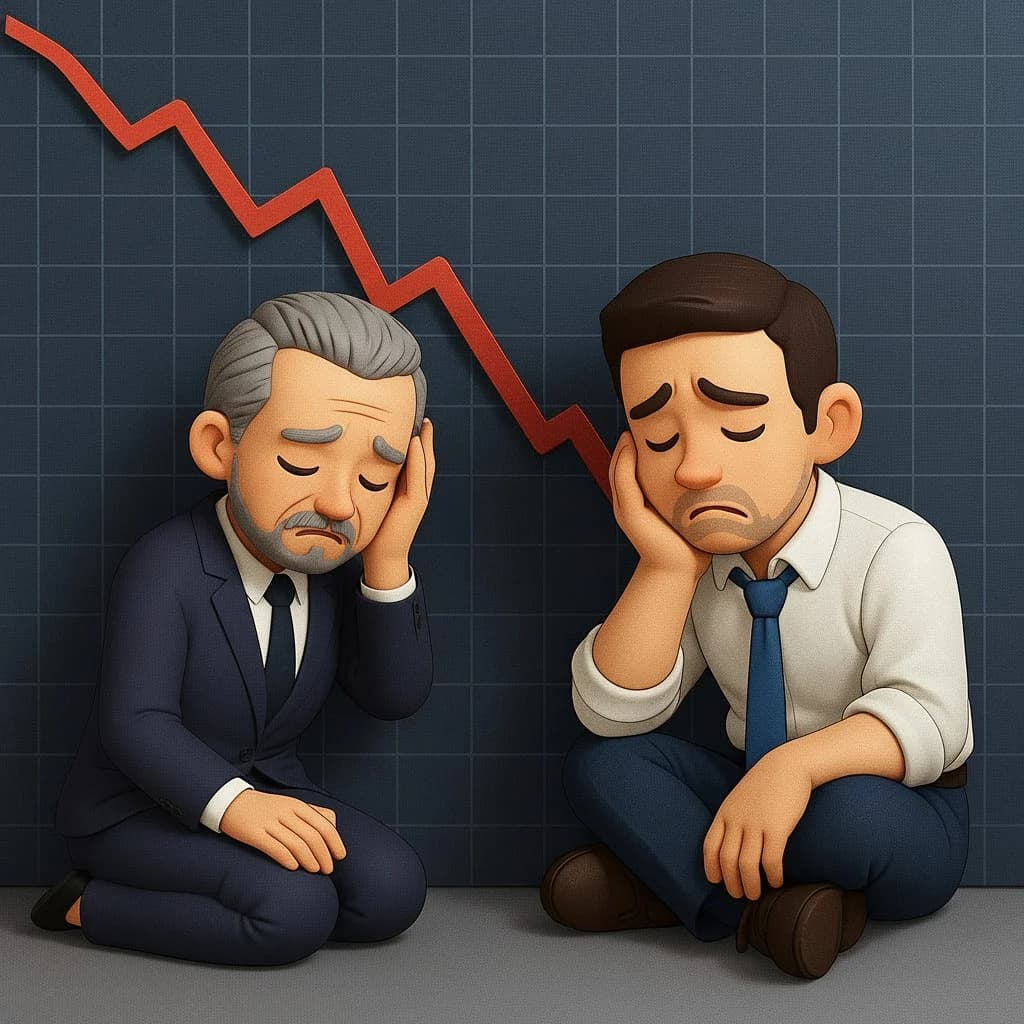
The sharp decline in U.S. semiconductor stocks and concerns over China's pursuit of the semiconductor industry have dealt a heavy blow to the domestic stock market. Investor sentiment contracted so rapidly that program sell-side circuit breakers were triggered in succession across both markets. While the U.S.-Iran war has entered a temporary lull in attacks, geopolitical uncertainty continues to weigh on sentiment as it has not led to a full ceasefire or end to the war.
KOSPI and KOSDAQ Plunge Together in Early Trading
On the 28th, the KOSPI opened at 6,400.27, down 355.48 points (5.26%) from the previous trading day. As losses widened rapidly right after the opening, a sell-side circuit breaker—a temporary suspension of program sell orders—was triggered in the securities market at around 9:06 a.m. The KOSDAQ also saw its decline deepen in early trading, prompting a sell-side circuit breaker at around 9:14 a.m.
As of 9:20 a.m., the KOSPI stood at 6,285.99, down 469.76 points from the previous session, after dipping as low as 6,245.70 during the session. It has been about three months since the KOSPI fell below the 6,300 mark during trading. While foreigners and institutions engaged in joint selling, retail investors responded with large-scale net buying.
Weakness in U.S. Semiconductor Stocks Delivers Direct Hit
The direct backdrop for this decline is the weakness in semiconductor stocks seen in the U.S. market overnight. Nvidia fell 4.99%, SanDisk dropped 11.02%, ASML declined 5.80%, and Micron slipped 2.25%. The Philadelphia Semiconductor Index also fell 2.23%, and the selling pressure spread to major domestic semiconductor stocks.
Sharp declines in index-heavy semiconductor stocks such as Samsung Electronics and SK Hynix amplified the KOSPI's losses. Given the domestic market's characteristic of a large market capitalization share for semiconductor stocks, the correction in U.S. tech stocks is interpreted to have triggered program selling across the entire index.
China's Move Toward Semiconductor Self-Sufficiency Also a Burden
Concerns have grown that competition in the global memory chip market could intensify, as China's memory semiconductor company Changxin Memory Technologies surged on its first day of trading and reports emerged that China is expanding the development and production of deep ultraviolet lithography equipment needed to manufacture advanced semiconductors.
U.S.-Iran Uncertainty Persists Despite Pause in Attacks
While the intensity of attacks in the U.S.-Iran war has temporarily diminished, uncertainty remains. The United States and Israel attacked Iran on February 28, and Iran subsequently retaliated against U.S. military bases and neighboring countries, causing the war to spread across the Middle East. The two sides reached a provisional agreement to end the war in June, but it did not last long.
After Iran attacked three merchant ships passing through a major maritime shipping route on July 7, the United States resumed airstrikes on Iran, and the two sides exchanged missile and drone attacks for about two weeks. Recently, attacks by both sides halted amid diplomatic movements by mediating countries, but the Iranian Foreign Ministry stated that it had not requested the resumption of negotiations with the United States, revealing a temperature gap over the outlook for talks.
Rising Casualties and Statistical Classification Controversy
U.S. Department of Defense tallies at one point showed 18 U.S. military deaths and 482 injuries, but controversy over statistical classification later arose when four recently deceased U.S. service members and some injured personnel were moved to a separate category called 'overseas operations.' President Trump also confirmed that the total number of U.S. fatalities was 18. A U.S. official told the Associated Press that the actual number of injured far exceeds 500.
The scale of Iranian civilian casualties varies significantly depending on the time of counting and the organization. The United Nations Office for the Coordination of Humanitarian Affairs reported that as of March 30, more than 2,100 civilians had been killed and more than 27,900 injured in Iran. As military clashes have continued since then, the current casualty figures are likely higher, but the exact cumulative toll has not been confirmed due to communication restrictions and access issues on the ground.
[This article was written with the assistance of AI. This article is for informational purposes only and does not recommend the purchase or sale of any specific stock. Intraday stock prices and trading volumes are subject to continuous fluctuation.]
CBC Globe publishes verified stories with editorial review, source checks, and tenant-specific publication standards.
Related Articles
Hanwha Solutions Public Offering Subscription Closes… Integrated Competition Rate Reaches 43.08 to 1
![[Breaking] SK Hynix Plunges 13%... '1.5 Million-Nix' Inevitable, KOSPI Crashes 9.5%](/_next/image?url=https%3A%2F%2Fmedia.cbcglobe.com%2Ftenants%2Fcbc00000-0000-4000-8000-000000000001%2Fmedia%2Fcbc%2F2026%2F07%2F588754%2F5f28c33aa48a73e6%2Fvariants%2Fhero.webp&w=1920&q=75)
[Breaking] SK Hynix Plunges 13%... '1.5 Million-Nix' Inevitable, KOSPI Crashes 9.5%
![[Breaking] KOSDAQ Bio Stocks and Preferred Shares Hit Upper Limits Simultaneously…Spotlight on Inflow of Demand into 'Low-Float' Stocks](/_next/image?url=https%3A%2F%2Fmedia.cbcglobe.com%2Ftenants%2Fcbc00000-0000-4000-8000-000000000001%2Fmedia%2Fcbc%2F2026%2F06%2F579783%2F4e4da2bfb8f012b9%2Fvariants%2Fhero.webp&w=1920&q=75)
[Breaking] KOSDAQ Bio Stocks and Preferred Shares Hit Upper Limits Simultaneously…Spotlight on Inflow of Demand into 'Low-Float' Stocks
![[Breaking] Alteogen Falls Below 300,000 Won Level... Investment Sentiment Shrinks Amid Plummet in KOSPI and KOSDAQ](/_next/image?url=https%3A%2F%2Fmedia.cbcglobe.com%2Ftenants%2Fcbc00000-0000-4000-8000-000000000001%2Fmedia%2Fcbc%2F2026%2F06%2F580321%2F018d96012c23d9d5%2Fvariants%2Fhero.webp&w=1920&q=75)