What's Today's Gold Price?... Pure Gold at 827,000 Won Amid International Gold Rebound... U.S. Employment, Prices, Dollar, and Real Interest Rates as Key Variables
According to **Korea Gold Exchange prices as of July 31, 2026**, major domestic precious metal prices rose across the board, showing a rebound. Pure gold, along
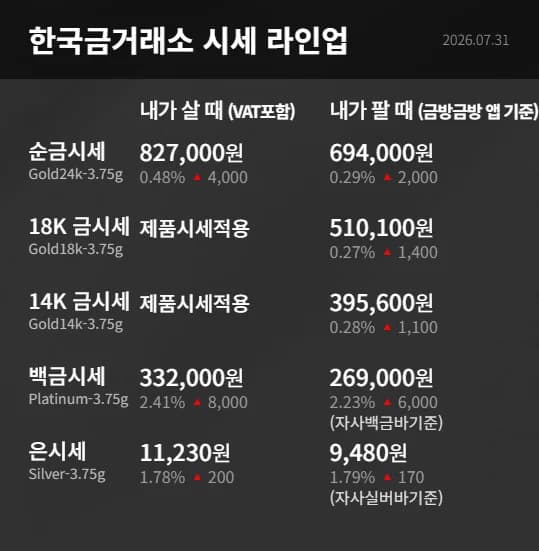
According to Korea Gold Exchange prices as of July 31, 2026, major domestic precious metal prices rose across the board, showing a rebound. Pure gold, along with 18K and 14K gold, platinum, and silver, all recorded gains compared to the previous trading day.
Domestic Precious Metal Prices (as of July 31)
The price of pure gold (24K, 3.75g) was recorded at 827,000 won for buying and 694,000 won for selling. The buying price rose 0.48% (up 4,000 won) from the previous trading day, while the selling price also increased 0.29% (up 2,000 won).
The 18K gold selling price stood at 510,100 won, up 0.27% (up 1,400 won) from the previous trading day.
The 14K gold selling price was 395,600 won, up 0.28% (up 1,100 won) from the previous trading day.
Platinum (3.75g) was quoted at 332,000 won for buying and 269,000 won for selling. The buying price rose 2.41% (up 8,000 won) from the previous trading day, while the selling price climbed 2.23% (up 6,000 won).
Silver (3.75g) was recorded at 11,230 won for buying and 9,480 won for selling. The buying price increased 1.78% (up 200 won) from the previous day, while the selling price gained 1.79% (up 170 won).
International Gold Prices Rise in Tandem... Coupled with Wall Street Rally
Meanwhile, Wall Street surged, driven by Microsoft's surprise earnings and a rebound in semiconductor stocks, and international gold prices rose alongside it. As risk appetite recovered, particularly in tech stocks, a weaker dollar and cooling U.S. inflation appear to have drawn funds into the gold market.
On July 30 (local time), the international gold market saw spot gold prices reach $4,104.59 per troy ounce, up about 1% from the previous trading day. A roughly 0.8% decline in the value of the U.S. dollar reduced the burden of gold prices traded in dollars, contributing to the increase. Additionally, the U.S. June Personal Consumption Expenditures (PCE) price index fell 0.1% from the previous month, which partially alleviated concerns about further rate hikes and supported gold prices.
On Wall Street, the Dow Jones Industrial Average closed up 1.19% at 52,208.06. The S&P 500 Index rose 1.66%, and the Nasdaq Composite Index surged 2.78%. As Microsoft's cloud business growth and returns on artificial intelligence investments were confirmed, buying spread to semiconductor and large-cap tech stocks.
Unusual Trend of Stocks and Gold Rising Simultaneously
Typically, when the stock market rebounds strongly, gold, a safe-haven asset, is likely to weaken. However, this rally was focused on individual corporate earnings catalysts, while uncertainty over monetary policy persisted in bond and foreign exchange markets.
Long-term Treasury yields rose to their highest levels since 2007, and differences of opinion within the Federal Reserve (Fed) over the direction of interest rates emerged, leading investors to simultaneously buy both risk assets and gold.
Although the Fed kept the benchmark interest rate frozen at 3.50–3.75%, the future policy path became even more uncertain. The probability of a rate hike in September, as priced in by the market, dropped from around 77% just before the FOMC meeting to about 61%.
Historical Relationship Between Gold Prices and Interest Rates
Because gold does not pay interest, higher interest rates generally reduce its investment appeal. However, when rising interest rates stem from inflation anxiety and declining policy credibility, demand to hedge against currency depreciation can flow into the gold market.
The relationship between gold and monetary policy has evolved in tandem with changes in the international financial system since the 1970s. Under the Bretton Woods system, established in 1944, the U.S. dollar was fixed at an exchange rate of $35 per ounce of gold. However, as more dollars circulated overseas than the gold reserves held by the United States, maintaining the system became difficult, and President Richard Nixon suspended the convertibility of dollars into gold in 1971.
After the fixed exchange rate system collapsed, gold prices began to be determined freely in the market. In the 1970s, with double-digit inflation, oil shocks, and a declining dollar value, the price of gold, which had been $35 per ounce, surpassed $800 in 1980. At the time, gold emerged as a representative means of preserving asset value when inflation eroded the purchasing power of fiat currency.
There are also counterexamples. In the 1980s, when the United States implemented a tight monetary policy and real interest rates rose, gold prices entered a prolonged correction phase. As government bonds and deposits offering high interest rates became more attractive, demand for non-interest-bearing gold declined. Gold prices then continued a long bearish trend until 2001.
Gold regained attention following the 2008 global financial crisis. As central banks around the world lowered benchmark interest rates and supplied massive liquidity, demand grew to hedge against currency depreciation and financial system instability. International gold prices approached $1,900 per ounce in 2011, surpassing the nominal record high set in 1980.
Expanded Volatility in the 2026 Gold Market
The gold market in 2026 is exhibiting much greater volatility than in the past. International gold prices hit an all-time high in January, surpassing $5,500 during intraday trading, but fell below $4,000 by the end of June. As interest rate expectations, the value of the dollar, and fund flows in futures and exchange-traded funds (ETFs) repeatedly shifted within short periods, gold's volatility has also exceeded its long-term average.
The current rebound in gold prices can be seen as the result of a complex interplay of factors — including a weaker dollar, inflation uncertainty, Middle East tensions, and questions over monetary policy credibility — rather than simply a flight from stock market declines. While Wall Street has risen on the back of corporate earnings, the long-term bond market continues to price in high inflation and policy uncertainty.
Key Variables Ahead
Going forward, U.S. employment and price indicators, the value of the dollar, and movements in real interest rates are expected to be the key variables in the gold market. Additionally, factors to watch include: the possibility of a rate hike at the September FOMC meeting, international oil prices, military tensions in the Middle East, and whether central banks continue to purchase gold.
The current trend of simultaneous gains in both the stock market and gold prices suggests that the market is reflecting both economic optimism and anxiety over currency value at the same time.
※ This article is provided for informational purposes only and does not constitute investment advice or a recommendation to buy or sell. The final decision and responsibility for investments rest with the investor.
CBC Globe publishes verified stories with editorial review, source checks, and tenant-specific publication standards.
Related Articles
![[Breaking] GC Green Cross Q2 Operating Profit at KRW 1.7 Billion... Down 93.8% Year-on-Year](/_next/image?url=https%3A%2F%2Fmedia.cbcglobe.com%2Ftenants%2Fcbc00000-0000-4000-8000-000000000001%2Fmedia%2Fcbc%2F2026%2F07%2F587626%2F362af6d78adda143%2Fvariants%2Fhero.webp&w=1920&q=75)
[Breaking] GC Green Cross Q2 Operating Profit at KRW 1.7 Billion... Down 93.8% Year-on-Year
![[IPO Subscription Closes] Ingenia Therapeutics Subscription Ends After Two Days... Equal Allocation 30.58 Shares, Proportional Competition Ratio 5.16:1](/_next/image?url=https%3A%2F%2Fmedia.cbcglobe.com%2Ftenants%2Fcbc00000-0000-4000-8000-000000000001%2Fmedia%2Fcbc%2F2026%2F06%2F584318%2F3f8d652ffc109a17%2Fvariants%2Fhero.webp&w=1920&q=75)
[IPO Subscription Closes] Ingenia Therapeutics Subscription Ends After Two Days... Equal Allocation 30.58 Shares, Proportional Competition Ratio 5.16:1
![[Breaking] LNC Bio Conducts 140.6 Billion Won Paid-In Capital Increase Followed by 1-for-1 Free Increase... Full-Scale Facility Investment](/_next/image?url=https%3A%2F%2Fmedia.cbcglobe.com%2Ftenants%2Fcbc00000-0000-4000-8000-000000000001%2Fmedia%2Fcbc%2F2026%2F07%2F587624%2F92a22c34058cf1b1%2Fvariants%2Fhero.webp&w=1920&q=75)
[Breaking] LNC Bio Conducts 140.6 Billion Won Paid-In Capital Increase Followed by 1-for-1 Free Increase... Full-Scale Facility Investment
![[Breaking] Samsung Electronics Closes Up 26.81%... SK Hynix Hits Upper Limit in Semiconductor Rally](/_next/image?url=https%3A%2F%2Fmedia.cbcglobe.com%2Ftenants%2Fcbc00000-0000-4000-8000-000000000001%2Fmedia%2Fcbc%2F2026%2F07%2F593584%2Fc683eb33392bd865%2Fvariants%2Fhero.webp&w=1920&q=75)