
600 Billion Won Invested as Pohang AI Data Center Kicks Off in Earnest... 'Operations to Begin in First Half of 2028'
A project to build an artificial intelligence (AI)-dedicated data center in Pohang, North Gyeongsang Province, with a total project cost of 600 billion won, is
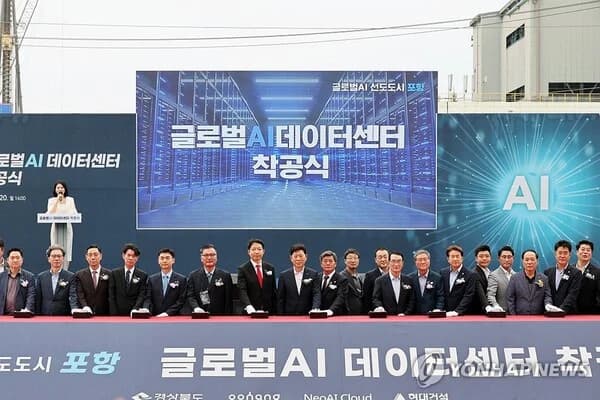
A project to build an artificial intelligence (AI)-dedicated data center in Pohang, North Gyeongsang Province, with a total project cost of 600 billion won, is being pursued in earnest with the support of the government's Regional Vitalization Investment Fund. A project to build a large-scale Battery Energy Storage System (BESS) in Yeonggwang County, South Jeolla Province, has also been selected, accelerating the expansion of region-tailored infrastructure.
Pohang AI Data Center Breaks Ground in Earnest... Targets Operation in First Half of 2028
Selected as the ninth project of the Regional Vitalization Investment Fund, the 'Pohang AI Data Center' will be built in the Gwangmyeong General Industrial Complex in Ocheon-eup, Nam-gu, Pohang, North Gyeongsang Province. A total of 600 billion won will be invested to build a GPU-based, water-cooled, high-performance data center with a power capacity of 40MW (IT load of 32MW).
Unlike existing general-purpose computing-focused data centers, this facility is specialized for AI workloads that analyze and process massive amounts of data in real time. Having already secured major permits and power supply, a groundbreaking ceremony was held on the 20th of last month, with the goal of beginning operations in the first half of 2028.
This project highlights lower land costs compared to the Seoul metropolitan area, reduced load design and reinforcement costs due to its single-story structural design, and industry-leading energy efficiency with a Power Usage Effectiveness (PUE) of 1.25 as its core competitive advantages. Additionally, it has already secured demand for 20MW, which is half of the total power capacity, from a leading domestic data center operator.
During the construction period, the project is expected to create about 4,300 jobs and induce 1.2 trillion won in production. Furthermore, it is anticipated to have a positive impact on revitalizing the local economy through expanded industrial investment linked to the attraction of global big tech companies.
1.798 Trillion Won BESS Project in Yeonggwang, South Jeolla Province, Also Selected
As the 10th project of the Regional Vitalization Investment Fund, a Battery Energy Storage System (BESS) project to be promoted in Sinha-ri, Yeonggwang-eup, Yeonggwang County, South Jeolla Province, has been selected. With a total investment of 179.8 billion won, this project will install a BESS with a maximum discharge capacity of 80MW and a storage capacity of 480MWh.
Based on a 15-year long-term contract signed with the Korea Power Exchange last year, it will be operated according to the charging and discharging instructions of the Korea Power Exchange. Having completed major permits, construction began in the first half of this year, with the plan to complete construction in December and start operations early next year.
The Yeonggwang BESS will contribute to grid stabilization and improved utilization of renewable energy by storing electricity during periods of high renewable energy generation and supplying it during periods of high demand. In particular, it is expected to efficiently utilize surplus power in the Honam region to expand the power infrastructure necessary for fostering high-tech industries, including the three mega-projects.
Regional Vitalization Investment Fund Investing a Total of 4.4 Trillion Won
The Regional Vitalization Investment Fund, which backs such large-scale regional projects, raised a master fund of 800 billion won by 2024 and is currently investing a total of 4.4 trillion won in 10 projects.
Under this structure, the master fund is formed with contributions from government finances, the Local Extinction Response Fund, and the Korea Development Bank, after which local governments and the private sector establish feeder funds and project Special Purpose Companies (SPCs) to carry out projects on a scale of at least 10 times the master fund's investment. The master fund invests up to 50% of the feeder fund, while the feeder fund bears about 20% of the total project cost, with the remainder financed through private sector financial loans.
The government is providing various support measures through the fund, including risk sharing, shortening or exempting fiscal investment reviews, special guarantees from the Housing and Urban Guarantee Corporation (HUG), and education and consulting.
A Ministry of Economy and Finance official stated, "We plan to continue striving to enhance the substance of fund operations through the Regional Vitalization Investment Fund by providing in-depth education to local governments and creating platforms for cooperation among operators, investment institutions, and local governments."
CBC Globe publishes verified stories with editorial review, source checks, and tenant-specific publication standards.
Related Articles

Lee Kang-in Set for First Match in Atletico Jersey... Named to 27-Man Squad for Coupang Play Series
13th Jeju Samdasoo Masters Opens... KLPGA Goes All Out on Safety Amid Heatwave Concerns

Son Heung-min's 4-Game Scoring Streak Halts... LAFC Defeats Chivas After Penalty Shootout Thriller