
Full Tuition Support for 60,000 Regional National University Freshmen Starting Next Year... Private Universities' Backlash and Other Controversies
The government is pushing a plan to provide full scholarships covering approximately 600 billion won in annual tuition for about 60,000 incoming freshmen at reg
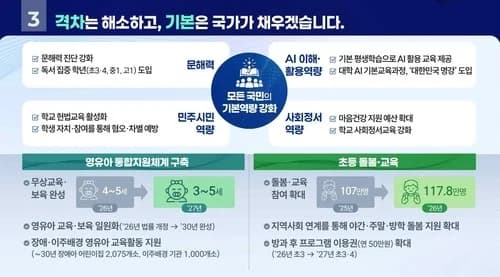
The government is pushing a plan to provide full scholarships covering approximately 600 billion won in annual tuition for about 60,000 incoming freshmen at regional national universities starting next year. Factoring in existing national scholarship support, the actual additional funding needed is estimated at around 100 billion won. Once consultations with budget authorities are finalized, the specific support methods and eligible targets will be announced at the end of this month.
[Strengthening Competitiveness of Regional Universities... Private University Scholarship Support Also to Expand] This policy was designed to prevent young people from leaving their regions and to enhance the competitiveness of regional universities. The Ministry of Education expects that providing students from the metropolitan area with opportunities to attend and live near regional universities will increase the likelihood of them settling in or returning to those regions after graduation.
In addition, the government plans to expand employment-linked contract departments—programs based on agreements between universities and companies—centered around regional universities. Scholarship support for students at regional private universities, not just regional national universities, will also be increased. The existing 'Regional Talent Scholarship' was only available to non-metropolitan high school graduates attending regional universities, but the plan is to overhaul the system so that metropolitan high school graduates can also receive scholarships when enrolling in regional private universities.
[Private Universities Strongly Protest 'Reverse Discrimination'... 'Competitiveness Will Inevitably Decline'] In response to the Ministry of Education's policy, protests are emerging from regional private universities and private universities in Seoul. The planning director of a private university in Seoul argued, 'If benefits are concentrated only on students at regional national universities, regional students who come to Seoul will face relative reverse discrimination.'
Regional private universities also pointed out, 'National university tuition is already at 60% of private university levels; if full scholarships are additionally provided, private universities' competitiveness will inevitably decline.' Hwang In-sung, Secretary-General of the Korean Council for University Education, expressed concern, stating, 'If national universities launch a student recruitment drive using full scholarships ahead of the 2027 early admissions, private universities will inevitably be pushed out.'
[Presidential Office Work Report on the 5th... CSAT and College Admissions Overhaul, and Free Childcare Expansion Discussed] The Ministry of Education announced a plan to introduce a regional balanced scholarship system during a report on '2026 Second Half Work Plans,' presided over by President Lee Jae-myung at the Presidential Office guesthouse on the 5th. Minister of Education Choi Gyo-jin stated, 'We will establish a new scholarship system so that freshmen at regional national universities can focus on their studies without worrying about tuition.' He also added that alongside expanding national scholarships, various support measures will be prepared to attract outstanding young people to regional areas.
During the work report that day, college admissions reform measures were also discussed, including the introduction of descriptive and essay-based evaluations in the College Scholastic Ability Test (CSAT) and high school academic records, as well as a transition to absolute evaluation. The National Education Commission plans to gather public opinions in the second half of this year and finalize a plan by March of next year. National Education Commission Chairperson Cha Jung-in pointed out, 'The current multiple-choice-oriented testing system forces students to merely repeat problem-solving.'
President Lee Jae-myung also mentioned the limitations of the multiple-choice CSAT, emphasizing the need to foster creative and individualized talent. However, concerns were also raised that expanding descriptive and essay-based evaluations could lead to side effects such as the expansion of the private education market. President Lee said, 'As changes in the admissions system can immediately lead to the formation of a new private education market or social conflict, careful discussion is necessary.'
Furthermore, a plan was also reported on the same day to expand the eligibility for free childcare and education for young children from the current 4–5 age group to 3–5 starting next year, aiming to raise the public childcare utilization rate to 55% by 2030.
CBC Globe publishes verified stories with editorial review, source checks, and tenant-specific publication standards.
Related Articles

600 Billion Won Invested as Pohang AI Data Center Kicks Off in Earnest... 'Operations to Begin in First Half of 2028'

Lee Kang-in Set for First Match in Atletico Jersey... Named to 27-Man Squad for Coupang Play Series
13th Jeju Samdasoo Masters Opens... KLPGA Goes All Out on Safety Amid Heatwave Concerns