
U.S. Marines Conduct First FPV Suicide Drone Live-Fire on Korean Peninsula… 6 Drones Hit Targets 0.9 km Away with Perfect Accuracy
The U.S. Marine Corps conducted a first-person view (FPV) suicide drone live-fire training on the Korean Peninsula for the first time on the 5th. In this traini
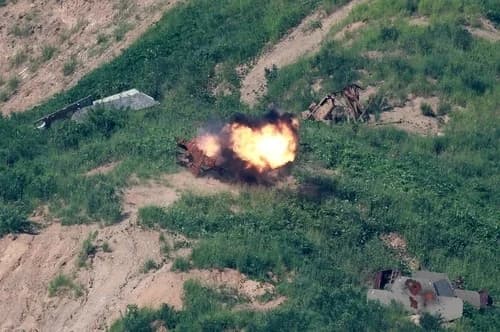
The U.S. Marine Corps conducted a first-person view (FPV) suicide drone live-fire training on the Korean Peninsula for the first time on the 5th. In this training, held about a week after a recent drone communication error incident between South Korea and the United States, six drones precisely struck targets located approximately 0.9 km away, achieving a perfect hit rate.
Service members from the 7th Regiment, 3rd Marine Division of the U.S. Marine Corps, participated in the training held at the Rodriguez Live Fire Complex in Yeongpyeong-ri, Yeongjong-myeon, Pocheon, Gyeonggi Province, as part of the Korea-U.S. Marine Corps Exchange Program (KMEP). They successfully destroyed targets using six 'Neros Archer' quadcopter-type suicide drones, operated by both the U.S. Army and Marine Corps.
◆ 'Hit-to-Kill' on 0.9 km Targets… Real-Time Precision Strike Demonstrated
The live-fire training, which began around 4:33 p.m., was conducted by sequentially deploying six drones to consecutively hit two targets at a distance of 900 meters. The drones were operated in a 'Hit-to-Kill' manner, destroying targets by direct collision, and precision guidance was achieved by monitoring the flight process in real time from a first-person view via onboard cameras.
◆ 'Neros Archer' Excludes Chinese Parts… Destructive Power Beyond Mortar Limitations
The 'Neros Archer' deployed in this training is the first FPV drone to receive the U.S. Department of Defense's 'Blue UAS' certification and is characterized by the minimal use of Chinese-made components. The unit price is approximately 7 million won.
Measuring 30 to 40 cm in length and width, it is small enough to fit in a backpack, but it can be equipped with anti-tank, anti-material, and anti-personnel weapons, with a payload capacity of 3 kg. Its maximum range is 25 km, and its maximum speed reaches 130 km/h. It possesses enough destructive power to penetrate 100 mm of standard tank armor.
The U.S. Marine Corps utilizes this drone for long-range reconnaissance and precision strikes at distances exceeding 20 km, surpassing the range of weapons systems organic to infantry rifle squads and platoons. This measure takes into account the fact that the 60 mm and 81 mm mortars operated by existing small units of the U.S. Marine Corps and the South Korean Army have a range of only 3 to 5 km and lower accuracy compared to FPV drones.
◆ Conducted Amid Heat Wave with Feels-Like Temperature of 37 Degrees… Background of Unusual Media Disclosure
On the day of the training, the Pocheon area experienced a heat wave with a feels-like temperature reaching 37 degrees, prompting a 'heat wave advisory' for most parts of the country. The live-fire exercise, originally scheduled for 3 p.m., was delayed by about an hour and a half to comply with safety procedures, but the training proceeded as planned despite the heat.
A U.S. Marine Corps official stated, "The weather on the battlefield does not bend to our will," emphasizing that directly experiencing Korea's hot and humid summer and freezing winter is an important opportunity.
This training, conducted by the 7th Regiment, 3rd Marine Division—which is not normally stationed on the Korean Peninsula but was temporarily deployed for training purposes—is interpreted as a measure to strengthen operational capabilities on the Korean Peninsula in the event of a contingency. In particular, it is extremely rare for the U.S. side to disclose KMEP training to the media.
Colonel Peter Ancinec, Deputy Commander of the U.S. Marine Corps Forces Korea, explained, "The core is combined readiness," adding, "It is a process of demonstrating capabilities in the terrain of the Korean Peninsula and establishing standard operating procedures (SOP) and tactics, techniques, and procedures (TTP) with the South Korean military." However, regarding additional information related to the training, he only replied, "The information disclosed to the media is all."
Kenneth Innocentio, Head of Neros Asia-Pacific Business Division, also emphasized, "The goal is to provide unmanned capabilities that do not rely on Chinese-made components to allied nations," reiterating that the Neros Archer is the first FPV drone to receive the U.S. Department of Defense's 'Blue UAS' certification.
CBC Globe publishes verified stories with editorial review, source checks, and tenant-specific publication standards.
Related Articles

KBS 2TV 'Love Is on Its Way' Kim Mujin and Han Gyurim Reunite at a Police Station After 8 Years Following an Unexpected Accident... Cold Gazes ('Episode 4')

Ji Seung-hyun and Young-tak Collaborate on 'Hard Tteokbokki'... Air Fryer Cooking and Fortune Reading on 'Convenience Store Restaurant'

Nonghyup Mobilizes to Minimize Heatwave and Drought Damage... 5,900+ Cooling Shelters in Operation and Field Recovery Support Strengthened
