August 7, 2026: Gold, Silver, and Platinum Prices Fall in Tandem...Profit-Taking and Oil Rebound Weigh After Surge
August 7 Domestic Precious Metals Prices: Gold, Silver, and Platinum All Decline As of August 7, 2026, according to Korea Gold Exchange prices, pure gold purcha
August 7 Domestic Precious Metals Prices: Gold, Silver, and Platinum All Decline
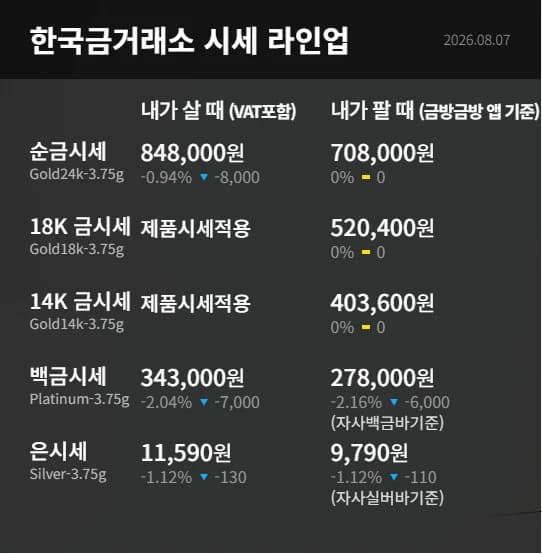
As of August 7, 2026, according to Korea Gold Exchange prices, pure gold purchase prices declined, while platinum and silver also showed weakness.
Pure gold (3.75g) was priced at 848,000 won when buying, down 8,000 won (-0.94%) from the previous day. Meanwhile, the selling price remained unchanged at 708,000 won (0% change) from the prior day. 18K held steady at 520,400 won for selling, and 14K maintained the previous day's level at 403,600 won for selling, both with no change.
Platinum saw a relatively larger decline. It was recorded at 343,000 won for buying (-2.04%, down 7,000 won) and 278,000 won for selling (-2.16%, down 6,000 won). Silver also continued its downward trend, trading at 11,590 won for buying (-1.12%, down 130 won) and 9,790 won for selling (-1.12%, down 110 won).
International Gold Prices Pressured by Profit-Taking and Oil Rebound Immediately After Sharp Rally
Despite all three major New York indices closing lower, gold prices actually dipped slightly, appearing directionless. Behind this lie two downward pressures: profit-taking following a short-term surge and a rebound in international oil prices, along with uncertainty over the U.S. interest rate path.
The most direct cause of the decline was the magnitude of the previous day's surge itself. International gold prices jumped approximately 3.67% in a single day as U.S. Treasury yields fell, the dollar weakened, and Middle East geopolitical dynamics shifted, even breaching the $4,300 level. This marked the largest single-day gain since February. Given the sharp increase in such a short period, the emergence of profit-taking sell orders was a natural market response.
Compounding this was the variable of rebounding oil prices. As international oil prices rose again, wariness about upward inflation pressure resurfaced, which weighed on the gold market. If rising oil prices stimulate consumer inflation, concerns grow that the U.S. Federal Reserve (Fed) may maintain higher interest rates for longer or even consider additional hikes. Since gold is a non-yielding asset, its investment appeal diminishes as market interest rates rise, meaning that interest rate uncertainty itself acts as a factor capping gold prices.
COMEX Gold Futures and Spot Both Dip Slightly
Looking at the actual figures, August COMEX gold futures settled at $4,242 per troy ounce, down $3.80 (0.09%) from the previous trading day. Spot gold traded around $4,244.29 in the latter half of the U.S. market session, and U.S. gold futures also slipped slightly to around $4,299.60. This effectively halted the two-day consecutive upward trend at this point.
New York Stock Market: Clear Risk-Off Sentiment
During the same period, risk-off sentiment was clearly evident in the New York stock market. Based on the close on August 6 local time:
- Dow Jones Industrial Average: 53,885.16, down 463.96 points (-0.85%)
- S&P 500: 7,709.98, down 13.57 points (-0.18%)
- Nasdaq Composite: 26,348.35, down 15.09 points (-0.06%)
- Russell 2000: 3,001.85, down 17.34 points (-0.57%)
Early in the session, major indices attempted to rise, but selling volume increased near highs, causing a broad reversal into negative territory. Given that stock market weakness typically benefits safe-haven assets like gold, the fact that gold prices also weakened alongside equities in this instance is noteworthy. This suggests that profit-taking and oil-driven interest rate concerns outweighed safe-haven demand.
Future Gold Price Outlook: Tug of War Between Upside and Downside Factors
However, if New York stock market volatility expands again or U.S. Treasury yields and the dollar's value decline further, safe-haven demand could revive, potentially shifting capital back into gold. Gold prices are expected to search for direction for the time being, caught between upside factors such as stock market weakness and geopolitical uncertainty, and downside factors including oil prices and interest rate burdens.
Key variables to watch going forward include: △ U.S. employment data releases △ movements in U.S. Treasury yields and the dollar's value △ changes in Middle East geopolitical dynamics. If economic indicators come in weaker than market expectations, concerns about prolonged Fed tightening could ease, potentially providing upward momentum for gold prices. Conversely, if data exceeds expectations or oil prices continue to rise, the likelihood of a deeper short-term correction remains open.
However, this is only a probability based on market variables identified thus far and should not be considered a definitive forecast.
[※ This article is not intended to solicit investment, and all investment decisions and responsibilities lie with the investor.]
CBC Globe publishes verified stories with editorial review, source checks, and tenant-specific publication standards.
Related Articles
SK Enics Plunges Over 5% During Trading... Attention Focuses on Whether 50,000 Won Level Will Hold

Robot Stocks Decline Across the Board... Rainbow Robotics and SPG Weaken, While Clobot Sees a Surge in Trading Volume
Samsung Electro-Mechanics Recovers 1.28 Million Won Level and Shows Strength... KOSPI and KOSDAQ Show Mixed Trends
![[Breaking] Renewable Energy Stocks Surge Across the Board... S Energy and SDN Jump Over 20%, Hanwha Solutions Rises Nearly 20%](/_next/image?url=https%3A%2F%2Fmedia.cbcglobe.com%2Ftenants%2Fcbc00000-0000-4000-8000-000000000001%2Fmedia%2Fcbc%2F2026%2F08%2F594282%2Fa11e3219b605116c%2Fvariants%2Fhero.webp&w=1920&q=75)