Typhoon Dolphin Strikes Okinawa... All Flights Canceled, Weekend China Region Routes Face Successive Disruptions
**Typhoon Dolphin Strikes Okinawa... Major Airports Closed and Full-Scale Flight Cancellations** As Typhoon Dolphin No. 13 approached the waters east of Okinawa
Typhoon Dolphin Strikes Okinawa... Major Airports Closed and Full-Scale Flight Cancellations
As Typhoon Dolphin No. 13 approached the waters east of Okinawa, Japan on the afternoon of the 7th, major airports in the Okinawa area are being closed and flights are being entirely canceled, with damages continuing to mount.
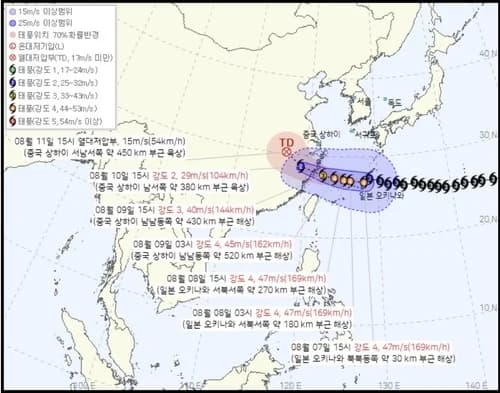
According to the Japan Meteorological Agency, Typhoon Dolphin passed through the waters northwest of Okinawa on the 7th at a speed of 144 km/h, and was forecast to pass approximately 70 km west of Okinawa around 3:00 a.m. on the 8th. At that time, it is expected to maintain a very strong intensity with a central pressure of 955 hPa (hectopascals) and maximum wind speeds of 40 m/s. The strong wind radius reaches 450 km, and is expected to gradually decrease to 390 km on the 9th and 360 km on the 10th. The Meteorological Agency forecast that strong winds and heavy rain would continue until the 9th and urged residents to take shelter indoors.
After passing Okinawa, Typhoon Dolphin is expected to enter the East China Sea in a west-northwest direction and reach waters 530 km southeast of Shanghai, China, on the 10th.
[Subtitle] From FSCs to LCCs... Large-Scale Flight Cancellations Pour In
Due to the direct and indirect effects of the typhoon, significant disruptions to flight operations are expected. As airports located hundreds of kilometers from the center of the typhoon fall within the strong wind influence zone, a chain of cancellations continues.
Korean Air pre-announced the possibility of irregular operations for flights to Okinawa through the 8th. It also informed that routes to China-region destinations, including Taipei Taoyuan, Fuzhou, Hangzhou, and Shanghai, may be affected from the 8th to the 10th. Asiana Airlines also announced that cancellations or delays may occur on Okinawa Airport routes until 11:59 p.m. on the 8th. It then stated that disruptions are expected on Taipei routes from 9:00 p.m. on the 8th through the 9th, and on Hangzhou and Shanghai routes from the 9th through the 10th.
Low-cost carriers (LCCs) are also responding swiftly. Jin Air announced the possibility of non-operation for Incheon-Miyakojima, Ishigaki, and Okinawa routes, and fully canceled the Busan-Okinawa route. Eastar Jet confirmed the cancellation of Incheon-Okinawa flights ZE631 and ZE632 on the 7th. Jeju Air announced potential operation changes for routes to Okinawa, Taipei, Kaohsiung, and Shanghai Pudong Airport, while T'way Air notified of possible flight variations on Okinawa, Taipei Songshan, and Jeju routes. Each airline added that affected routes and periods may change at any time depending on the typhoon's path and intensity.
[Subtitle] Blow to Peak Season... LCCs' Lack of Spare Aircraft May Prolong Stranded Periods
Currently, as aviation demand in early August hits its annual peak, the average load factor on Okinawa and Taiwan routes has exceeded 90%, meaning that flight cancellations caused by the typhoon are leading to large-scale damages. Given the nature of short-haul resort routes, which attract many family travelers, there is a high possibility that flight cancellations could lead to secondary damages such as the cancellation of local accommodation reservations. There is also a precedent of large-scale cancellations at airports in southwestern Japan, including Okinawa, caused by Typhoon Jangmi in June of this year.
In particular, LCCs that do not have sufficient capacity to operate spare aircraft may struggle to arrange alternative flights, potentially extending passengers' stranded periods by two days or more. Accordingly, airlines stated that they are monitoring local airport conditions and the typhoon's path in real time and will swiftly decide on additional cancellations or delays.
[Subtitle] Fee Waivers Apply Only After 'Official Cancellation'... Wait for Notice to Minimize Losses
Cancellation fee waivers are applied only after an airline's cancellation is officially confirmed. If a passenger cancels their reservation first based solely on adverse weather forecasts, standard fees will be charged as usual, so it is advisable to wait for an official cancellation notice to minimize financial losses.
As disruptions to major international flight operations to destinations such as Taiwan and Shanghai are expected to continue through the weekend, travelers are urged to exercise special caution. (The photo is a virtual image generated by Google AI Gemini.)
CBC Globe publishes verified stories with editorial review, source checks, and tenant-specific publication standards.
Related Articles

'You Quiz on the Block' Features Lee Eun-gyeol and Lee Seung-cheol... Takes No. 1 Ratings, Christopher Nolan and Matt Damon Set to Appear Next Week

LE SSERAFIM's Huh Yunjin, CORTIS, and KATSEYE Named in U.S. Variety's '2026 Young Hollywood Impact'

Saturday, August 8 Chinese Zodiac Horoscopes: Complete Guide to Overall Fortune, Love, Wealth, Health, Lucky Colors, and Numbers