
Won Falls 107 Won in July... Yet Commercial Bank Dollar Deposits Actually Increase
**[Dollar Deposits Surge Amid Record Current Account Surplus]** In June, the current account recorded a surplus of $49.73 billion, setting an all-time high. Thi
[Dollar Deposits Surge Amid Record Current Account Surplus]
In June, the current account recorded a surplus of $49.73 billion, setting an all-time high. This figure surpassed the entire surplus of the first half of last year ($49.37 billion) in just one month. Amid this strong performance, large-scale surpluses are expected to continue on a year-over-year basis in July and August as well.
Meanwhile, dollar deposit balances at the five major commercial banks (KB Kookmin, Shinhan, Hana, Woori, and NH Nonghyup) increased significantly during the month of July. According to the banking sector, dollar deposit balances at the five major banks grew from $64.945 billion to $69.421 billion between July 3 and August 5, an increase of $4.476 billion.
During the same period, corporate dollar deposits increased by 7.03%, from $52.917 billion to $56.642 billion, while individual dollar deposits also rose by 6.24%, from $12.028 billion to $12.779 billion. In particular, the upward trend in dollar deposits became more pronounced entering August. The total dollar deposit balance, which stood at $64.147 billion at the end of June, reached $67.183 billion at the end of July, an increase of $3.036 billion in a single month. Subsequently, an additional $2.238 billion was added in just the first three business days of August, reaching 73.7% of the previous month's total increase. If the current trend continues, the balance is estimated to reach $82.103 billion at the end of August, up $14.92 billion from the previous month.
[Fewer Incentives to Exchange Currency Amid Falling Exchange Rates... "Holding Onto Dollars"]
The strong performance of semiconductor exports underpins the increase in corporate dollar deposits. With an abundance of dollars earned from exports and the continued decline in the exchange rate, companies are choosing to hold onto their dollars rather than exchanging them for Korean won.
The decline in the won-dollar exchange rate, partly due to the domestic inflow of funds from SK Hynix's American Depositary Receipts (ADR) listing, also contributed to companies expanding their dollar holdings. As the exchange rate fell, the incentive to convert dollars into won diminished significantly. It is also reported that as the exchange rate stabilized, government pressure on companies to convert their dollars eased.
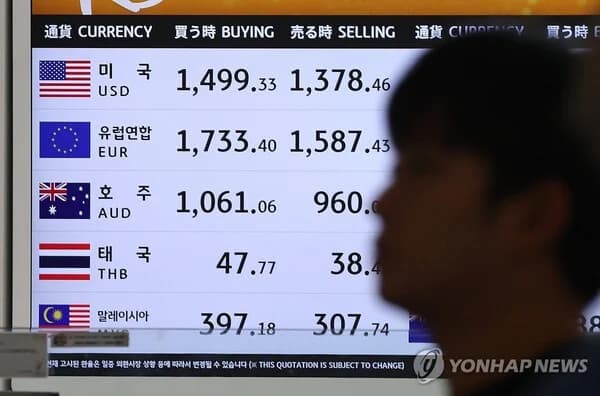
In fact, the won-dollar exchange rate (base rate) fell by 107.3 won over the month of July, from 1,548.4 won on July 1 to 1,441.1 won at the end of July. By August 5, it had dropped further to 1,428.2 won, a decline of roughly 120 won in just one month.
A commercial bank official explained, "Due to the exchange rate decline, the government's pressure on companies to convert dollars has weakened, and as a result, there is a stronger tendency for companies to stockpile their earned dollars as deposits rather than exchanging them." Expectations of a future exchange rate rebound also support the expansion of corporate dollar deposits.
Park Hyung-joong, an economist at Woori Bank, analyzed, "With the domestic inflow of SK Hynix ADRs continuing until the middle of this month, the downward trend in the exchange rate is expected to persist for the time being. However, if a strong dollar emerges next month depending on the U.S. Federal Reserve's (Fed) benchmark interest rate decision, the exchange rate could rise again, so companies are stockpiling dollars in advance."
[Individual Investors Also "Hoarding Cheap Dollars"... Steady Demand for Overseas Investment and Travel]
Individual dollar deposits have also been significantly impacted by the exchange rate decline. The banking sector reports that demand has increased among those seeking to secure dollars at lower prices in preparation for U.S. stock investments, overseas travel, and overseas direct purchases.
Economist Park added, "As recent volatility in the domestic stock market has weakened investor confidence in the KOSPI, and the won-dollar exchange rate has fallen below market expectations, individual demand for exchanging currency into dollars for overseas investment or travel preparations has increased."
CBC Globe publishes verified stories with editorial review, source checks, and tenant-specific publication standards.
Related Articles

President Lee Jae-myung Orders Comprehensive Reconsideration of ISA Overhaul and Stock Price Suppression Prevention Act... "Reflect Investor Criticism"
![[MLB] Lee Jung-hoo Extends Hit Streak to 6 Games with Game-Winning RBI… San Francisco Wins 5-2](/_next/image?url=https%3A%2F%2Fmedia.cbcglobe.com%2Ftenants%2Fcbc00000-0000-4000-8000-000000000001%2Fmedia%2Fcbc%2F2026%2F08%2F596112%2Fc9e9d434b1b44b41%2Fvariants%2Fhero.webp&w=1920&q=75)
[MLB] Lee Jung-hoo Extends Hit Streak to 6 Games with Game-Winning RBI… San Francisco Wins 5-2

Worker in His 60s Killed After Being Struck by Garbage Truck in Seoul's Changsin-dong... Police and Ministry of Employment and Labor Investigating