President Lee Jae-myung: "Honam Semiconductors: Beyond a Speed War to a Blitzkrieg"… Orders Temporary Relocation of Gwangju Military Airbase by Mid-2028
The second public-private joint review meeting on the 'Three Major Mega Projects' was held, presided over by President Lee Jae-myung. The meeting was attended by key figures including Chief of Staff Kang Hoon-sik, Policy Chief Kim Yong-beom, and National Security Office Director Wi Sung-lac from the
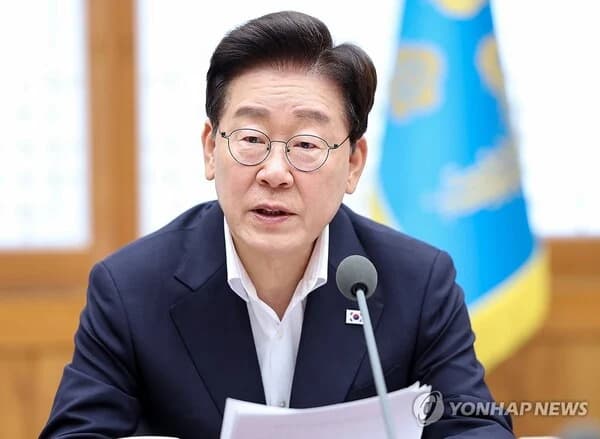
The second public-private joint review meeting on the 'Three Major Mega Projects' was held, presided over by President Lee Jae-myung. The meeting was attended by key figures including Chief of Staff Kang Hoon-sik, Policy Chief Kim Yong-beom, and National Security Office Director Wi Sung-lac from the presidential office, as well as Prime Minister Han Seung-sook, Deputy Prime Minister and Minister of Economy and Finance Koo Yoon-chul, and Deputy Prime Minister and Minister of Science, Technology, and ICT Bae Kyung-hoon.
Also in attendance were ministers from relevant ministries including the Ministry of National Defense, the Ministry of Trade, Industry and Energy, the Ministry of Land, Infrastructure and Transport, the Ministry of Climate, Energy and Environment, and the Ministry of Economy and Finance, along with the Minister of Government Policy Coordination, the Chairman of the Joint Chiefs of Staff, the Chief of Staff of the Air Force, and the Mayor of the Honam-Jeolla Integrated Special City. From the corporate side, Samsung Electronics President Kim Yong-kwan and SK President in Charge of Future Growth Jeong Seung-il were also present.
[Reorganizing the Regional Growth Axis… Preemptively Blocking 'K-Shaped Polarization'] At the meeting, President Lee urged each ministry to exercise careful management to ensure that mega projects do not become concentrated on any single company or region. He explained that the ultimate goal of the mega projects is to expand the axis of growth across the entire nation and to redraw the map of ultra-gap industries around regional centers. He also emphasized the need to proactively establish measures to prevent 'K-shaped growth,' a form of growth polarization.
In particular, he mentioned the need for support across the entire industrial ecosystem, including materials, parts, and equipment, as well as the need to formulate a strategy that enables physical artificial intelligence (AI) to serve as the core driver of manufacturing transformation. President Lee stated, "Once investments are made and factories are built, it is already too late," stressing that plans to promote inclusive growth must be considered from the very early stages of the projects. He instructed the ministries to prepare in advance so that the achievements built through the collective capabilities of the community do not become concentrated in specific companies or regions.
[Speed War to Eliminate Regulatory and Infrastructure Obstacles] The importance of swift administrative support from the government was also repeatedly emphasized. President Lee instructed a comprehensive review to ensure that companies' willingness to invest is not undermined and procedures are not delayed due to inter-ministerial silos, regulations, or a lack of infrastructure. He added that related procedures should be pursued simultaneously to significantly reduce the time required, and that regulations should be continuously improved to accelerate the pace of execution.
[Early Utilization of Gwangju Military Airbase Site… A 'Blitzkrieg' for the Semiconductor Cluster] Regarding the establishment of the Honam-region semiconductor cluster, he further emphasized the importance of swift administrative action. President Lee characterized the situation as one where "we must go beyond a speed war and wage a blitzkrieg," directly ordering the Ministry of National Defense to take swift measures for the early utilization of the Gwangju military airbase site. He requested that the Gwangju base's functions be temporarily relocated to another military airbase by mid-2028 so that the site can be rapidly converted into a semiconductor industrial park. He also asked that efforts be made to ensure that construction of the industrial park can begin early on land near the airbase even before the temporary relocation is completed.
He then referenced the example of Kumamoto, Japan, reiterating that the Honam semiconductor cluster must be executed with comparable speed. He called for ensuring there are no disruptions in the preparation of basic infrastructure such as power and water, and asked for swift promotion of the enactment and revision of related laws through close communication with the National Assembly.
Finally, President Lee concluded the meeting by urging, "Consider the next year as the golden time and give it your all," emphasizing that now is the moment when the 'Golden Age' of the Republic of Korea begins.
CBC Globe publishes verified stories with editorial review, source checks, and tenant-specific publication standards.
Related Articles
Democratic Party Leadership Race: Kim Min-seok Takes Lead... Final Results on 17th as Honam and Capital Region Emerge as 'Decisive Battlegrounds'
Seoul Private Apartment 59㎡ Sale Price Surpasses 1.5 Billion Won… Nears Triple the National Average
Han Byung-do: "Housing Supply Delays, Responsibility of Previous Administration and Opposition"… Jang Dong-hyuk Criticizes "Government That Abandoned the People"