
Trump Considers Declaring Victory on 'Strait of Hormuz Reopening' in Iran Conflict... Missile Depletion and Netanyahu's Resistance Emerge as Variables
Tensions between the United States and Iran are entering a new phase. It has been reported that President Donald Trump is considering downscaling his war goals in negotiations with Iran to the 'complete reopening of the Strait of Hormuz,' and declaring victory on that basis. The United States faces
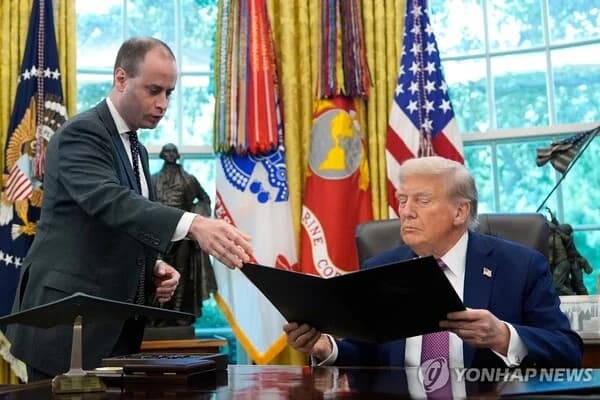
Tensions between the United States and Iran are entering a new phase. It has been reported that President Donald Trump is considering downscaling his war goals in negotiations with Iran to the 'complete reopening of the Strait of Hormuz,' and declaring victory on that basis.
The United States faces a complex situation in which the prevention of Iran's nuclear weapons development and the issue of control over the Strait of Hormuz are intertwined. Iran, citing imminent consultations with Oman, has signaled its intention to impose control and transit fees on ships passing through the strait, aiming to expand its influence. The United States strongly opposes recognizing Iran's control, fearing that China could take similar actions in the Taiwan Strait or the South China Sea.
Mohammad Bagher Zolghadr, Secretary-General of Iran's Supreme National Security Council, presented six preconditions for opening the strait. The conditions are as follows: • Lifting the U.S. counter-blockade • Lifting of sanctions • Withdrawal of U.S. forces from waters around Iran • Payment of war reparations • Full release of frozen Iranian assets • Cessation of attacks on Iran-affiliated groups in the region and threats against Iran
President Trump's attempt to scale back war objectives is the result of a combination of factors, including the absence of a clear solution, military and economic burdens, and domestic political dynamics. Experts at the Center for Strategic and International Studies (CSIS) and Eurasia Group analyzed that President Trump is increasingly struggling to find a way to exit the war while saving face.
Within the United States, concerns have been raised that the military's inventory of interceptor missiles and long-range precision-strike missiles has been significantly depleted and that it will take years to replenish them. Analysts note that if the United States were to launch a large-scale airstrike against Iran, retaliatory attacks by Iran and its neighboring allies in the Middle East could further deplete U.S. missile stockpiles, which would negatively impact U.S. deterrence against China, Russia, and North Korea. The deployment of ground troops to secure control of the Strait of Hormuz has also been discussed, but with the November midterm elections approaching, it is realistically difficult to choose this option due to the potential for American military casualties.
Meanwhile, President Trump recently indicated in an interview with the U.S. online media outlet Axios that he would intensify economic pressure instead of launching additional military attacks against Iran. Acknowledging Iran's severe inflation and economic difficulties, he stated he would monitor the current situation. However, he expressed optimism about negotiations with Iran and emphasized his commitment to resolving the issue through economic pressure.
The Wall Street Journal (WSJ) reported that President Trump recently told senior aides in private that the likelihood of Iran resuming its nuclear development during his term is low because the United States destroyed three of Iran's key nuclear facilities last year. He also expressed confidence that U.S. intelligence capabilities could detect any Iranian attempts to rebuild, and that the threat of further strikes would serve as a deterrent. The United States has long been preparing various denuclearization proposals, including the removal of Iran's stockpile of highly enriched uranium and the establishment of a moratorium on uranium enrichment.
It has been revealed that President Trump has actually discussed with his aides a plan to declare victory and withdraw troops based solely on the reopening of the Strait of Hormuz. He recently shared an article on Truth Social from the U.S. online outlet 19FortyFive titled 'Donald Trump Has Won the Iran War.'
Meanwhile, on another front in the Middle East, differences with Israel remain unresolved. Israeli Prime Minister Benjamin Netanyahu announced at a cabinet meeting that he rejects the disarmament agreement with Hamas brokered by President Trump. Prime Minister Netanyahu stated that the Israel Defense Forces (IDF) would not withdraw from the Gaza Strip until Hamas is disarmed, clearly diverging from the proposal President Trump put forward at the end of last month, which included a cessation of Israeli airstrikes and troop withdrawal concurrent with the start of Hamas's disarmament. Prime Minister Netanyahu's hardline stance ahead of the October general election is interpreted as an effort to consolidate his support base.
As the United States grapples with these multifaceted crises, Iran has recognized the American dilemma and is moving to gain the upper hand in negotiations by setting even higher conditions.
CBC Globe publishes verified stories with editorial review, source checks, and tenant-specific publication standards.
Related Articles

Dingo Music Becomes Official Partner of the 5th Blossom Youth Music Festival... Establishes 'Dingo Music Award' Amid 17.8-to-1 Competition Among 142 Teams

DPR CREAM·ARTIC Successfully Wrap Up Mexico Tour… Reveal 22-Song Setlist and 4 Unreleased New Tracks
![[Official] Sung Hoon Cast as Lead in MBN's New Romance 'The Boss's Obvious Taste'... 'Transforms into AI Genius Chaebol' (Premieres in November)](/_next/image?url=https%3A%2F%2Fmedia.cbcglobe.com%2Ftenants%2Fcbc00000-0000-4000-8000-000000000001%2Fmedia%2Fcbc%2F2026%2F08%2F596987%2Fd3a22a02c3a4cfee%2Fvariants%2Fhero.webp&w=1920&q=75)
[Official] Sung Hoon Cast as Lead in MBN's New Romance 'The Boss's Obvious Taste'... 'Transforms into AI Genius Chaebol' (Premieres in November)