
Government Introduces First National Setback Distances for Renewable Energy… "Solar Limited to 200m, Wind to 1500m"
The government will introduce a national cap on setback distances for the first time to expand the siting of renewable energy generation facilities. Under this measure, solar facilities will be subject to a maximum setback distance of 200m from residential areas, while wind power facilities will be
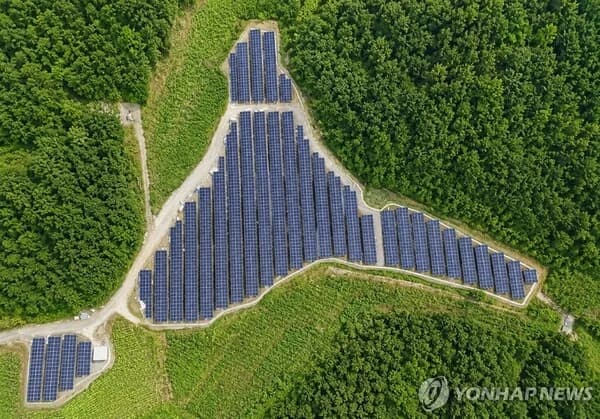
The government will introduce a national cap on setback distances for the first time to expand the siting of renewable energy generation facilities. Under this measure, solar facilities will be subject to a maximum setback distance of 200m from residential areas, while wind power facilities will be limited to 1,500m from residential areas and 500m from roads. Accordingly, excessive setback regulations previously established by local governments through ordinances are expected to be relaxed, making it easier to secure sites necessary for the expansion of renewable energy deployment.
To date, 129 out of 228 municipal governments nationwide have independently established their own setback distance rules. The distances varied significantly by region, ranging from 100 to 1,000m for solar and 100 to 2,000m for wind power. This has been cited as a cause of reduced predictability in the licensing process for power generation businesses and a constraint on site selection.
As a follow-up measure to the law amended in March, the revised Enforcement Decree of the Act on the Promotion of Development, Use, and Dissemination of New and Renewable Energy, which passed the Cabinet meeting, will take effect on September 18. The main contents of the revision are as follows.
- *■ Detailed Standards for Solar and Wind Setback Distance Caps**
- Solar: Setback distances may only be set within a maximum of 200m from residential areas with five or more housing units. Local governments that previously had regulations exceeding 200m, such as 300m, 500m, or 1,000m, must revise their ordinances downward. However, setback distance regulations will not apply to community-based solar generation facilities, building-rooftop solar, or self-consumption solar installations.
- Abolition of Road Setback Distance Regulations: Regulations on setback distances from roads for solar power generation facilities will be completely abolished. An initial proposal to maintain a 100m distance was considered, but it was removed during the re-legislative notice period based on the government's judgment that road setback distances are not directly related to safety or public acceptance.
- Wind Power: Setback distances of up to 1,500m from residential areas and up to 500m from roads may be established. In consideration of safety, a minimum distance equivalent to "twice the height of the generation facility" has been set as the lower limit.
- *■ Specific Areas Eligible for Exceptional Setback Distance Regulations**
- While the revised law原则上 prohibits local government heads from applying setback distance regulations in principle, exceptions have been made for specific areas.
- Historical and cultural environment conservation zones and protected areas under the Cultural Heritage Act
- Ecological and landscape conservation areas under the Natural Environment Conservation Act
- Tourist destinations and tourism complexes under the Tourism Promotion Act
- Natural rural districts under the Enforcement Decree of the National Land Planning Act
- In these exceptional areas, local governments may set setback distances through ordinances. However, even in these cases, the distances may not exceed the national caps of 200m for solar and 1,500m (residential areas) and 500m (roads) for wind power.
■ Separation of Related Laws and Future Schedule The existing legal framework, which previously governed new and renewable energy together, will be separated under this revision. Going forward, the laws will be divided into the Act on the Promotion of Development, Use, and Dissemination of Renewable Energy and the Hydrogen Economy Vitalization and Hydrogen Safety Management Act. The corresponding enforcement decrees will also be reorganized into the renewable energy and hydrogen sectors, respectively.
Local governments operating regulations stricter than the existing decree standards must revise their ordinances to fall within the cap before the law takes effect on September 18. The Ministry of Climate, Energy, and Environment plans to hold explanatory sessions for municipal governments nationwide to guide them through the ordinance revision process.
Lee Kyung-soo, Director-General for Renewable Energy Policy at the Ministry of Climate, Energy, and Environment, stated, "By establishing a national cap on setback distances that previously varied by region, we have improved the predictability of renewable energy projects while also taking public acceptance into consideration." He added, "We will continue communicating with local governments to ensure that the system takes root stably in the field and contributes to the expansion of renewable energy deployment."
CBC Globe publishes verified stories with editorial review, source checks, and tenant-specific publication standards.
Related Articles
![[Weather] Typhoon Chanhom Makes Landfall in Southern Ibaraki Prefecture, Japan — First Since 1951](/_next/image?url=https%3A%2F%2Fmedia.cbcglobe.com%2Ftenants%2Fcbc00000-0000-4000-8000-000000000001%2Fmedia%2Fcbc%2F2026%2F08%2F597416%2F6a086d68706f9587%2Fvariants%2Fhero.webp&w=1920&q=75)
[Weather] Typhoon Chanhom Makes Landfall in Southern Ibaraki Prefecture, Japan — First Since 1951
Colombia Hit by Largest 'Magnitude 7.4' Earthquake of the 21st Century: 164 Dead, 188 Missing

"Because We Have Different Blood Types..." Jun Hye-won, the Shocking Secret of Birth Revealed by a School Fire Accident