National Fire Mobilization Order Issued as Drought Worsens in Gyeongnam… 200 Water Tankers and 400 Firefighting Personnel Deployed Nationwide
The National Fire Agency (NFA) issued a "National Fire Mobilization Order" for the Gyeongnam region, where the drought has worsened, effective 8:00 PM on the 11th. Accordingly, 400 firefighting personnel and 200 water tankers from 16 city and provincial fire headquarters across the country, includin
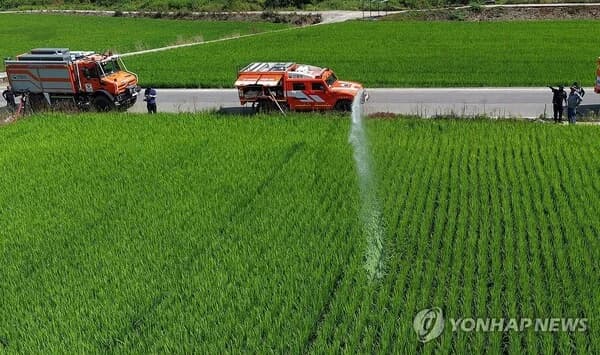
The National Fire Agency (NFA) issued a "National Fire Mobilization Order" for the Gyeongnam region, where the drought has worsened, effective 8:00 PM on the 11th. Accordingly, 400 firefighting personnel and 200 water tankers from 16 city and provincial fire headquarters across the country, including Seoul, Busan, Daegu, Incheon, and Gwangju, will be deployed to Gyeongnam to support the supply of agricultural and domestic water until the 13th.
The National Fire Mobilization Order is a system invoked when it is difficult to effectively respond to fires or disasters using only the firefighting capacity of a specific city or province, or when nationwide deployment of firefighting forces is necessary.
The drought in the Gyeongnam region is at its most severe level nationwide. According to data from the Agricultural Drought Management System (ADMS), the average reservoir level in Gyeongnam recorded a nationwide low of 33.5%. This figure is a mere 46.8% of the average reservoir level of 72% for a normal year. Currently, 17 out of 18 cities and counties in Gyeongnam have entered the "drought" stage for agricultural water, with three cities and counties—Miryang, Geoje, and Haman—specifically classified as being at the "severe" stage. The agricultural water drought stages are divided into four levels based on the reservoir level compared to a normal year: Attention (70% or below), Caution (60% or below), Alert (50% or below), and Severe (40% or below).
This measure follows the instructions of President Lee Jae-myung. During a meeting on the 6th to review the response to the heatwave and drought, President Lee ordered the full mobilization of all administrative resources to minimize damage to citizens. The Gyeongnam Fire Headquarters also requested national-level support, judging that its own firefighting capacity alone has limitations in providing water supply assistance amid the prolonged drought. An NFA official explained, "After a comprehensive review of the field situation, we determined that nationwide firefighting support was necessary."
The mobilized firefighting forces will gather at a staging area by 9:00 AM on the 12th before focusing their efforts entirely on water supply operations for two days. The water tankers will be distributed and deployed across the jurisdictions of 14 fire stations in Gyeongnam, including Jinju, Tongyeong, Sacheon, and Gimhae. The scale of deployment was determined by comprehensively considering regional reservoir levels, drought crisis stages, and the demand for water supply support.
Fire water tankers will be deployed to areas in urgent need of water and to water sources that were pre-selected by Gyeongnam Province and each city and county. Support will be concentrated primarily on areas experiencing significant inconvenience for residents due to a lack of domestic water, as well as agricultural regions suffering from severe drought damage. Choi Yong-chul, Acting Commissioner of the NFA, stated, "We will swiftly deploy all available firefighting forces nationwide to ensure that water is supplied in a timely manner to areas in need."
CBC Globe publishes verified stories with editorial review, source checks, and tenant-specific publication standards.
Related Articles
![[Weather] Typhoon Chanhom Makes Landfall in Southern Ibaraki Prefecture, Japan — First Since 1951](/_next/image?url=https%3A%2F%2Fmedia.cbcglobe.com%2Ftenants%2Fcbc00000-0000-4000-8000-000000000001%2Fmedia%2Fcbc%2F2026%2F08%2F597416%2F6a086d68706f9587%2Fvariants%2Fhero.webp&w=1920&q=75)
[Weather] Typhoon Chanhom Makes Landfall in Southern Ibaraki Prefecture, Japan — First Since 1951
Colombia Hit by Largest 'Magnitude 7.4' Earthquake of the 21st Century: 164 Dead, 188 Missing

"Because We Have Different Blood Types..." Jun Hye-won, the Shocking Secret of Birth Revealed by a School Fire Accident