Trump Claims Control of Strait of Hormuz, Signals Countermeasures Against Iran's Reparation Demands
As Iran demands sweeping concessions from the United States as a condition for reopening the Strait of Hormuz in an attempt to gain the upper hand in negotiations, U.S. President Donald Trump is countering with a strategy of economic pressure. ## Iran Presents Six Tougher Demands Beyond the MOU Mo
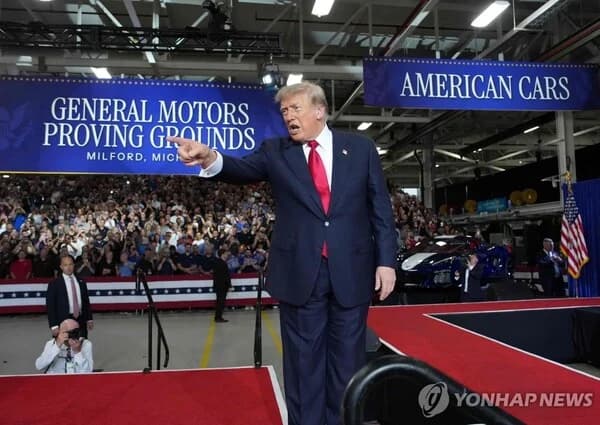
As Iran demands sweeping concessions from the United States as a condition for reopening the Strait of Hormuz in an attempt to gain the upper hand in negotiations, U.S. President Donald Trump is countering with a strategy of economic pressure.
Iran Presents Six Tougher Demands Beyond the MOU
Mohammad Baqer Zolghadr, Secretary-General of Iran's Supreme National Security Council (SNSC), stated on the 8th (local time) that for the Strait of Hormuz to be opened, the United States must meet six conditions: lifting maritime blockades and sanctions, withdrawing U.S. forces from around Iran, paying war reparations, and unconditionally releasing frozen assets. Iran pressured that if the U.S. does not accept these terms, the strait will not reopen.
These demands are significantly tougher than the memorandum of understanding (MOU) reached in June. At the time, conditions were attached to the release of frozen assets, but this time Iran has demanded an unconditional release, and the lifting of sanctions was explicitly stated as a prerequisite. Iran signaled that this proposal could also lead to further negotiations, including on the nuclear issue. This is interpreted as a strategy to secure a favorable position in future nuclear talks by leveraging control of the Strait of Hormuz.
Iran has also retained the card of blockading the Bab el-Mandeb Strait in the Red Sea through Houthi rebels as an additional negotiating lever.
Rising Oil Price Burden in the U.S. — A Factor Pressuring Negotiations
Iran's hardline stance appears to be based on the calculation that political pressure within the United States will mount over time. Following the U.S.-Iran conflict, gasoline prices in the U.S. have risen again, and according to the American Automobile Association (AAA), the national average gasoline price at the end of July exceeded $4 per gallon.
Iran's Deepening Economic Crisis — Food Prices Surge 128%
Iran's domestic economy is rapidly deteriorating. U.S. maritime blockades and airstrikes have damaged the country's industrial base, and according to Iran's Statistical Center, food prices rose 128% year-on-year between June 21 and July 20. Even high-income households in the capital, Tehran, are struggling to purchase daily necessities. Large-scale anti-government protests fueled by economic discontent earlier this year resulted in over 3,000 deaths, according to government figures.
Trump: "The Navy Is in Control" — Economic Pressure Over Military Threats
President Trump pointed to Iran's economic difficulties and emphasized economic pressure over military threats. In a phone call with Axios, he said, "We are only having contact with them on a level close to negotiations," and claimed, "Iran doesn't even have money to pay its soldiers, and the U.S. maritime blockade has deepened Iran's economic crisis." In a meeting with White House reporters, he stated, "The Strait of Hormuz is currently under the control of the U.S. Navy, and all naval mines have been cleared."
Reparations Battle — Trump: "Iran Should Be the One Paying Reparations"
When Iran demanded war damage compensation for the reopening of the Strait of Hormuz, President Trump countered by asserting that Iran should be the one paying reparations. He wrote on Truth Social, "Iran is demanding compensation for the damage it suffered during military clashes over the past five months. I have instructed the negotiating team that compensation should also be paid to the families of the hundreds of thousands of innocent protesters killed by Iran." He argued that Iran must also bear responsibility for the damage inflicted on the people of Lebanon, Syria, Yemen, and the Gaza Strip.
The Reality of the Strait and Outlook — "Iran Seeks to Block Trump's Exit Strategy"
U.S. media interpreted President Trump's claims that the strait is already open as an attempt to render Iran's demands meaningless. However, the New York Times pointed out that the Strait of Hormuz has effectively been closed since the outbreak of the war. According to Reuters, as of the 8th, the weekly average number of oil tankers of 10,000 deadweight tonnage (DWT) or more entering the Persian Gulf through the Strait of Hormuz was just 0.4, while the number exiting to the Arabian Sea was only 2.3.
The Wall Street Journal reported that President Trump had been preparing to declare victory in the war once the strait was fully reopened, but Iran's hardened conditions have narrowed his options. Foreign media analyzed that Iran is using the strait as a negotiating card to block President Trump's "exit strategy."
There is also skepticism about whether U.S. economic pressure can bring about a change in Iran's policies. Mehran Kamrava, a professor at Georgetown University's Qatar campus, assessed, "Iran's political system is highly repressive and is only interested in maintaining power. Despite prolonged U.S. pressure, Iran's position has not been significantly shaken."
CBC Globe publishes verified stories with editorial review, source checks, and tenant-specific publication standards.
Related Articles
Seoul's Seogye and Cheongpa-dong Redevelopment Projects Gain Momentum... Net Increase of 1,695 Households, Mayor Oh Se-hoon Inspects Site
Exports Surge 45.3% in Early August... Semiconductors Drive 46.8% of Total, Hitting Record High
Plan to Raise 710 Trillion Won with Six Financial Institutions to Build AI Infrastructure