ISEC 2026 Opens... Attention Turns to Shift Toward 'Autonomous Defense' System in the AI Era: "Cyber Threats Spreading Rapidly"
**'The 20th International Security Conference (ISEC 2026)' Successfully Held... "Urgent Need to Build AI Autonomous Defense System'** The cybersecurity conference 'The 20th International Security Conference (ISEC 2026)' is hosted by the ISEC 2026 Organizing Committee and co-organized by the Korea I
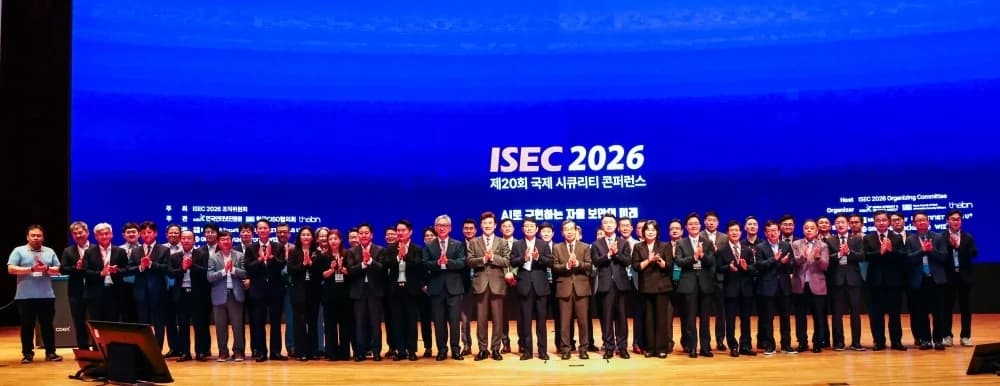
'The 20th International Security Conference (ISEC 2026)' Successfully Held... "Urgent Need to Build AI Autonomous Defense System'
The cybersecurity conference 'The 20th International Security Conference (ISEC 2026)' is hosted by the ISEC 2026 Organizing Committee and co-organized by the Korea Internet & Security Agency (KISA), the Korea CISO Council, and The BIEN. Under the theme 'The Future of Autonomous Security Realized by AI,' this year's event focuses on new security strategies and technologies required in the era of AI agents.
A total of 237 companies and institutions are participating in the event, with 124 sessions held across 24 tracks. There are also 166 exhibition booths showcasing the latest AI and security technologies. The organizing committee expects approximately 8,000 attendees, including Chief Information Security Officers (CISOs) from companies and government agencies, as well as security practitioners.
The Proliferation of 'AI Agents' and the Shift Toward 'Autonomous Defense'
This year's ISEC highlighted the proliferation of 'AI agents' that can autonomously set goals and perform tasks using system privileges. The analysis suggests that as AI is increasingly exploited across all stages of cyberattacks—including vulnerability discovery, phishing creation, and malware modification—it is becoming difficult for existing human-centric response systems to keep pace with the speed of these attacks.
Accordingly, the transition to an 'Autonomous Defense' system, where AI performs the entire process of threat detection, analysis, response, and post-incident learning, was presented as the core topic of this conference. Discussions also addressed newly emerging security challenges, such as account control and attack surface management, driven by the increase in AI and various non-human accounts.
Opening Ceremony and Congratulatory Remarks: "Need to Strengthen AI Security Competitiveness and Institutional Support"
At the opening ceremony held on the 11th, government officials, lawmakers, and industry stakeholders attended in large numbers, emphasizing the need to strengthen security competitiveness in the AI era.
- Lee Ki-joo, Chair of the ISEC 2026 Organizing Committee, stressed that a robust security foundation is essential for the development of the AI industry, noting, "Cases have emerged where AI models autonomously find software vulnerabilities and launch attacks."
- Ryu Je-myung, Vice Minister of Science and ICT, stated the ministry's plan to transition from a reactive, post-incident response system to a proactive prediction and response framework by utilizing AI across the entire process—from cyber threat collection and analysis to detection and response. He also outlined a strategy to enhance global competitiveness through the development of AI security technologies and the fostering of the information protection industry ecosystem.
- Kim So-jung, National Cyber Security Secretary at the Office of the President, emphasized that alongside AI-based defense systems, fundamental information security practices such as asset management, vulnerability assessments, and multi-layered defense remain crucial. She also expressed her commitment to eliminating security blind spots in small and medium-sized enterprises, local governments, and partner companies.
At the National Assembly, the importance of institutional support was also raised. In his congratulatory remarks, Representative Yun Young-seok pointed out, "The innovation brought by AI is a new driving force for national competitiveness, but at the same time, cyber threats targeting national infrastructure and advanced industrial ecosystems are spreading rapidly." Representative Cho In-chul mentioned the potential for attacks on physical AI and drone-operating AI, adding that not only technological security but also the human command system that manages and controls AI is vital. Song Ki-heon, Chairman of the National Assembly's Science, ICT, Broadcasting and Communications Committee, delivered a video message stating the need to distinguish between the roles of AI and humans, and to clarify the accountability system regarding AI's decisions and actions.
Key Sessions: Encompassing AI Integrated Security, Zero Trust, Cloud Security, and More
At ISEC 2026, a wide array of industry-leading security technologies and solutions are being introduced, including AI-based integrated security, Zero Trust, Software Bill of Materials (SBOM) and supply chain security, N2SF, and cloud security.
On the first day of the event, the 11th, presentations by various field experts followed. Park Yong-kyu, Head of the Digital Threat Response Division at KISA, presented strategies for utilizing AI as a security tool and discussed changes in the AI technology environment under the theme 'The Position and Utilization Direction of AI Amid Cyber Threats.' Kim Soo-young, Executive Director at Fortinet, shared autonomous security strategies utilizing AI-based automated detection and response, including measures to control Shadow AI and protect Large Language Models (LLMs).
Furthermore, Addeo John, Vice President at HackerOne, assessed that as the speed of vulnerability discovery by AI outpaces corporate response times, the issue of 'Exposure Debt'—the accumulation of security exposures—is worsening. Raymon van der Velde, CTO of Group-IB, noted that AI is lowering the cost and entry barriers for phishing, deepfakes, fraud, and synthetic identity attacks, urging the combination of threat intelligence and AI defense technologies.
Day 2 Lineup: Agentic Security and On-Site CISO Talk Concert
On the 12th, agentic security, cloud, and communications infrastructure security will be the main agenda items. Jang Kwang-woon, Security Strategy Advisor at Microsoft, will present a vision for agentic security where multiple AI agents collaborate to identify and respond to organizational threats. Kaiyang Cai, Vice President at cloud security company Wiz, will introduce the reality of how the increase in non-human service accounts and unmanaged shadow AI workloads are being exploited as new attack vectors, based on global cloud telemetry data. Choi Jong-bo, Executive at LG U+, will share his experience in building an integrated security system that combines security technologies with network infrastructure and line and edge capabilities.
In addition, a talk concert featuring CISOs from major domestic companies has been organized and is drawing significant interest. CISOs including Ji Jeong-ho of Toss, Kim Yeon-seok of Korea Electric Power Research Institute, Joo Jin-guk of Lotte World, and Lee Sang-guk, Executive Vice President of AhnLab, will engage in an in-depth discussion on field response strategies under the theme 'The Era of Autonomous AI Threats: The Current State of K-Security as Told by CISOs,' with Kim Jin-soo, President of the Korea Information Security Industry Association, serving as the moderator.
Meanwhile, customized programs for different sectors, including the '3rd CPO Workshop of 2026' and the '13th CISO Capacity Building Workshop,' will also be held concurrently during the event.
CBC Globe publishes verified stories with editorial review, source checks, and tenant-specific publication standards.
Related Articles

Heo Sung-tae Transforms into Crime Boss Baek Sang-gil in Netflix's 'This Damn Love'... Praised as "A Spoonful of Noir in a Rom-Com"

Yemen's Houthi Rebels Attack Ship in Bab el-Mandeb Strait with Missiles... 6 Crew Members Dead, 10 Injured
Actor Ha-young Issues Handwritten Apology Over Pro-Japanese Activities of Great-Grandfather Ahn Sang-ho: "I Also Reflect on the Initial 'Groundless' Response"