Trump to Allow Foreign Shipbuilders Investing in U.S. to Build Two Navy Vessels in Home Country... Hanwha's Eligibility Draws Attention
U.S. President Donald Trump is pursuing a plan to allow foreign shipbuilding companies that have invested in the United States to build an initial batch of U.S. Navy vessels at their home-country shipyards. Hanwha of South Korea, which recently acquired the Philadelphia Shipyard in the United States
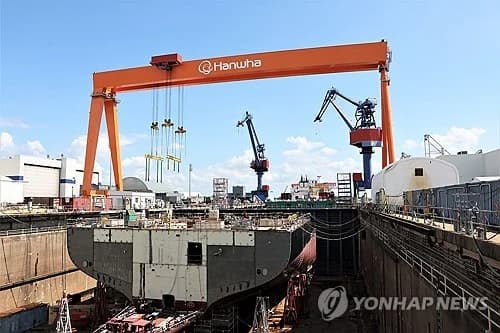
U.S. President Donald Trump is pursuing a plan to allow foreign shipbuilding companies that have invested in the United States to build an initial batch of U.S. Navy vessels at their home-country shipyards. Hanwha of South Korea, which recently acquired the Philadelphia Shipyard in the United States, is highly likely to be included among the entities eligible for this plan.
Conditions for Allowing Construction of Two Navy Vessels at Home-Country Shipyards
- According to a memorandum signed by President Trump on the 13th (local time), foreign shipbuilders that build new shipyards in the United States or acquire ownership or a majority stake in existing U.S. shipyards may build two U.S. Navy vessels at their home-country shipyards. However, eligible vessels are limited to the following three ship classes:
- Surface combatants
- Consolidated (CONSOL) fleet replenishment oilers
- Roll-On/Roll-Off (Ro-Ro) vessels
Any additional vessels beyond the first two must be built at U.S. shipyards.
President Trump demanded that foreign shipbuilders hire and train U.S. workers and transfer their proprietary construction techniques and technologies from their home-country shipyards to U.S. shipyards through licensing. He also set a condition mandating the use of domestic supply chains for any subsequent shipbuilding and maintenance activities conducted in the United States.
Expanded Application of the 'Finland Model' and Future Schedule
This plan represents an expanded application of the so-called 'Finland Model,' which the United States adopted last October in partnership with Finland to procure medium icebreakers. The underlying concept is to allow initial vessel production at overseas shipyards for speed, while transferring technology and production capabilities to the United States to enhance the competitiveness of the domestic shipbuilding industry.
President Trump is applying this model to a maximum of three ship classes and has directed the Secretary of Defense to submit a detailed procurement plan within 90 days of the memorandum's effective date. He instructed that the specific procurement methods for surface combatants—which carry out anti-submarine warfare, surface warfare, and convoy escort missions—be determined in consultation with the Secretary of the Navy. For non-combatant vessels, namely CONSOL oilers and Ro-Ro vessels, he directed that the procurement plan include measures to utilize funds committed under U.S. trade agreements for investment in the U.S. maritime industrial base.
Connection to Hanwha and the 'MASGA' Project
These measures are drawing close attention for their potential connection to 'MASGA,' a $150 billion-scale shipbuilding cooperation project being pursued under the U.S.-Korea Trade Agreement. In particular, since Hanwha has already acquired the Philadelphia Shipyard, observers note that it precisely meets the 'U.S. shipyard ownership' requirement set by President Trump and stands to benefit from the plan.
Curbing Design Changes... Addressing Procurement Delays
The directive also puts the brakes on frequent design changes, which have been cited as a major cause of delays in naval vessel procurement. President Trump emphasized that once the Navy places orders for vessels based on a well-developed baseline design, it must not demand repeated design changes.
CBC Globe publishes verified stories with editorial review, source checks, and tenant-specific publication standards.
Related Articles

Why an Emergency Disaster Alert Is Sent on CSAT Day... Used to Catch Test-Takers Who Fail to Submit Mobile Phones

Naver News Partnership Committee: Zero Media Outlets Pass 2026 Partnership Review as All Applicants Fail... Plans to Revise Criteria and Conduct Early 2027 Review

Hwang Min-hyun and TWS Release YouTube Cheer Videos Ahead of 2027 CSAT: "Good Luck on the CSAT!"