
Health Insurance Coverage for Fully Edentulous Implants Pursued from 2027... Deliberation and Vote Still Pending, 'Not Yet Confirmed'
Kim, 78, lost all of his remaining teeth a few years ago. When he visited a dentist with his children, the answer he received was different from what he expected. He knew he was over 65 and that a health insurance implant system existed, but he was told that he himself could not receive the benefit.
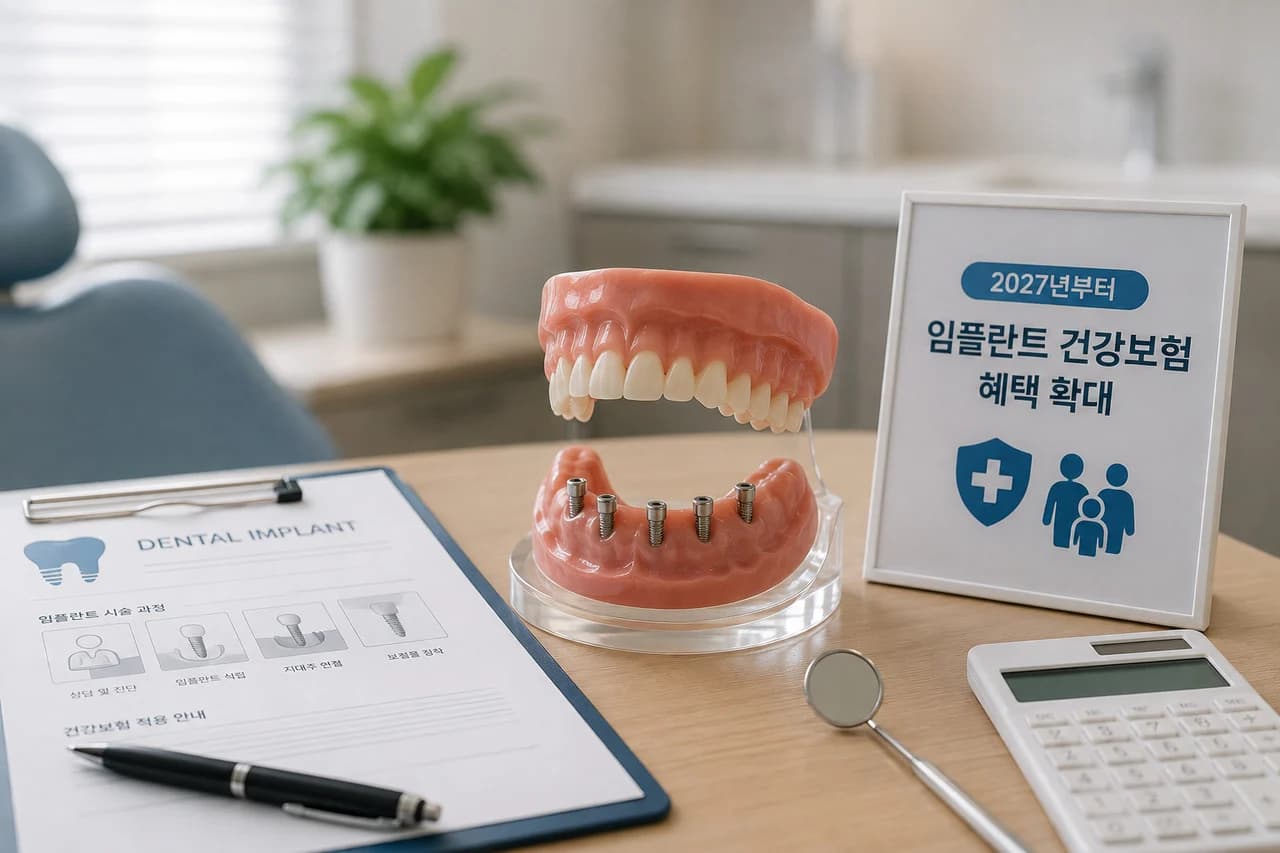
Kim, 78, lost all of his remaining teeth a few years ago. When he visited a dentist with his children, the answer he received was different from what he expected. He knew he was over 65 and that a health insurance implant system existed, but he was told that he himself could not receive the benefit. This was because he was in a completely edentulous state, with no teeth remaining.
The attending physician explained that health insurance coverage for implants applies only to partial edentulism—that is, cases where at least one natural tooth remains. If no teeth remain at all, the patient is classified as eligible for dentures rather than implants. In the end, Kim had to bear the entire cost himself, and his family had to pool funds to cover the burden.
■ Fully Edentulous Patients in Greater Need of Treatment Yet Left Outside Support
Kim's case is not an isolated one. Elderly people in a fully edentulous state, who struggle to eat due to impaired chewing function and experience changes even in speech and facial contours, are often in more urgent need of treatment. Nevertheless, the health insurance system has until now excluded those with no remaining teeth from coverage.
While elderly people with partial edentulism could receive health insurance implant benefits for up to two implants in their lifetime, those with complete edentulism—who needed treatment more urgently—remained outside the system. There have also been criticisms that the system has created irrational situations, with some cases emerging in the field where patients first paid out of pocket for implants and then belatedly applied for additional support.
■ Government to Pursue Health Insurance Coverage for Fully Edentulous Implants from 2027
According to some media reports, a change is expected. The government is pursuing a plan to apply health insurance to implant treatment for fully edentulous elderly patients starting in 2027, and a health insurance coverage innovation plan containing these details was reportedly reported to a subcommittee of the Health Insurance Policy Deliberation Committee.
However, it was also reported that the plan is being designed so that those receiving implant support cannot receive full denture support in duplicate, and only partial denture support would be available. The government reportedly plans to invest a substantial amount of health insurance funds into the program, and reports estimate that a significant number of elderly people would benefit from cost savings once implemented.
■ Not Yet Confirmed... 'Must Go Through Committee Deliberation and Vote'
The plan still needs to undergo deliberation and a vote by the Health Insurance Policy Deliberation Committee, and the Ministry of Health and Welfare has reportedly stated that nothing has been confirmed. As various policies are being reviewed together under the direction of expanding health insurance coverage, the final implementation and detailed conditions may change in future discussions.
■ Four Checkpoints for Elderly Patients and Families to Verify
For those already diagnosed with complete edentulism who have delayed treatment like Kim, one option is to first check the timing of the policy's confirmation and one's own eligibility rather than rushing into non-covered treatment. Conversely, if pain or functional decline is severe and treatment cannot be postponed further, consulting thoroughly with one's dentist and deciding on the timing of treatment should come first.
The checkpoints are as follows.
① It is necessary to get an accurate diagnosis of one's oral condition—whether one has partial or complete edentulism.
② It is important to watch whether the health insurance coverage plan for complete edentulism is actually confirmed through the Health Insurance Policy Deliberation Committee's deliberation, and if so, how the eligible scope and implementation timeline are specified.
③ It is also necessary to check whether the lifetime implant limit and cost-sharing conditions of the existing partial edentulism implant coverage may be adjusted as well.
④ If the structure prohibiting duplicate implant and full denture support is implemented as is, it is worth examining in advance whether implants or dentures would be more suitable for oneself.
[This article is an informational piece conveying a policy direction under government review based on some media reports. The plan has not been confirmed, as it is still at the stage before the Health Insurance Policy Deliberation Committee's deliberation and vote. Details such as eligible recipients, implementation timing, and cost-sharing rates may change depending on future government announcements and National Health Insurance Service notices. Actual treatment decisions and eligibility for health insurance coverage must be determined through dental consultation and verification with the National Health Insurance Service. Some assistance was provided by AI.]
CBC Globe publishes verified stories with editorial review, source checks, and tenant-specific publication standards.
Related Articles

At Heart Dominates Music Shows with Remix of Roo Ra's '3!4!'... Music Video Surpasses 2.4 Million Views

Actor Han Woo-yeol Delivers Passionate Performance as Enforcer Wan-seop in Film 'Hope'… Proves Strong Presence as a Scene-Stealer

ALPHARDRIVEONE Wins Global Rookie Award at '2026 TIMA'… Achieves Eighth Total Trophy in Debut Year
![[Video] Kim Min-kyung, Shin Bong-sun, and Jung Jin-wook Light Up Blue Carpet at 14th Busan International Comedy Festival Opening Ceremony](/_next/image?url=https%3A%2F%2Fmedia.cbcglobe.com%2Ftenants%2Fcbc00000-0000-4000-8000-000000000001%2Fmedia%2Fcbc%2F2026%2F08%2F600445%2F533fdda601d67af9%2Fvariants%2Fhero.webp&w=1920&q=75)