
[Seohak!Star] IonQ Unveils 6th-Gen Quantum Computer 'Superion 256' Combining Semiconductor Processes... Cryptography Cracking Blueprint and $8.18M Security Deal Accelerate Commercialization
IonQ (NYSE: IONQ) unveiled its sixth-generation quantum computing platform, 'Superion 256,' on the 8th (local time). Alongside the launch, the company announced research results estimating the resources needed for Shor's algorithm to break Bitcoin's cryptographic system in roughly 26 days, as well a

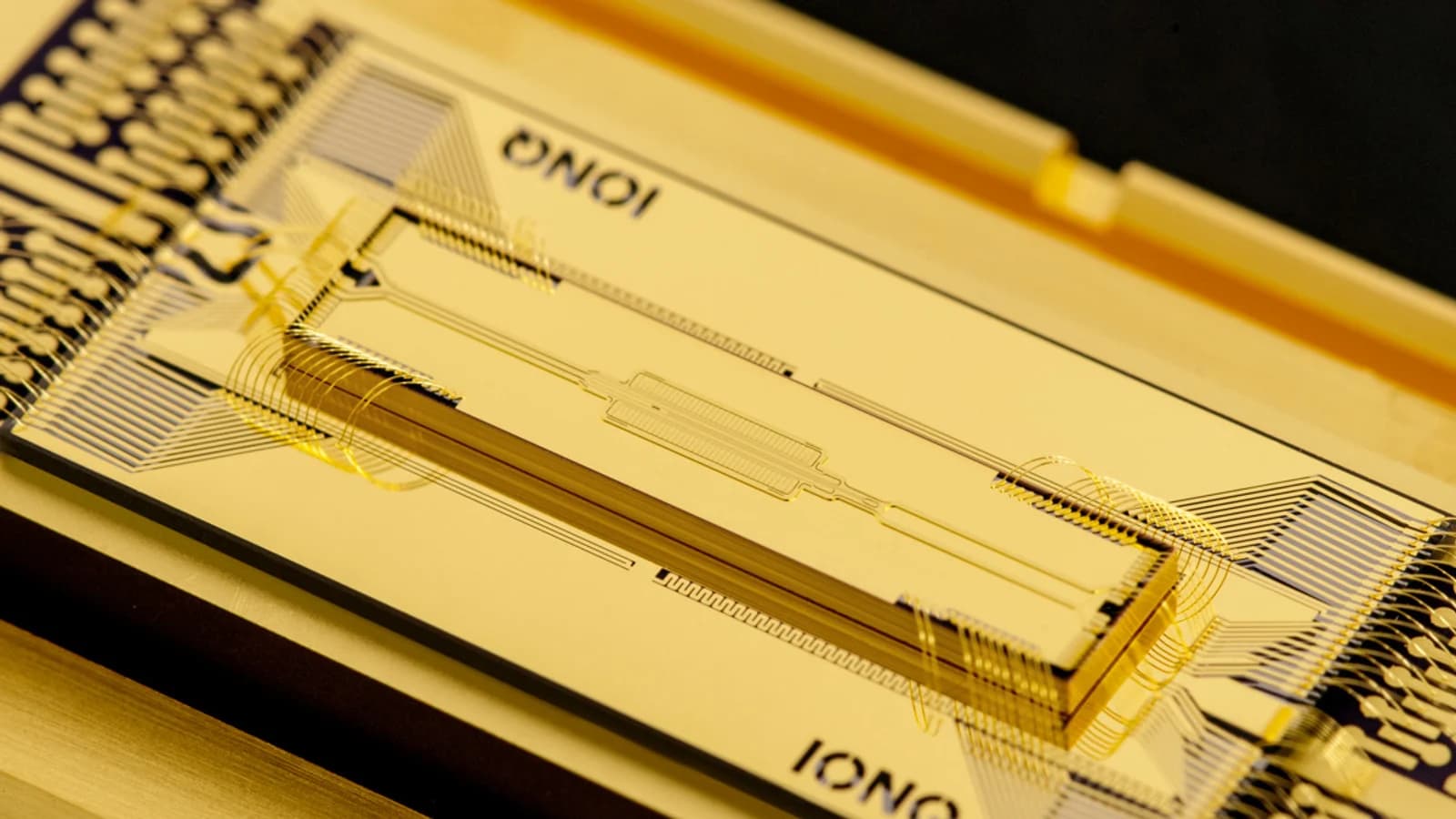
IonQ (NYSE: IONQ) unveiled its sixth-generation quantum computing platform, 'Superion 256,' on the 8th (local time). Alongside the launch, the company announced research results estimating the resources needed for Shor's algorithm to break Bitcoin's cryptographic system in roughly 26 days, as well as an $8.18 million quantum security commercial contract, simultaneously ramping up hardware mass production and tangible commercialization.
Notably, IonQ presented a vision to evolve Superion beyond a one-off laboratory test device into a platform that can be mass-produced at a scale of hundreds of units by incorporating semiconductor manufacturing methods. By demonstrating earlier than expected the threat timeline to existing public-key cryptography and signing a large quantum security contract with enterprise data management firm Congruity360, the company is pursuing technology development and market entry in parallel.
■ Less Than a Year from Initial Design to Ion Trapping... Design Cycle Shortened from 9 Months to 2 Months
The Superion 256 unveiled by IonQ is the first Superion platform that will serve as the foundation for its forthcoming next-generation computing product line. It took less than a year from initial design to the actual ion trapping stage. The company built a fully integrated 256-qubit quantum processing unit (QPU) at its subsidiary SkyWater and succeeded in trapping the first ions after constructing prototype systems at multiple facilities across the United States.
The chip co-designed and fabricated by IonQ and SkyWater went through six tape-outs in the first half of 2026 alone. Through the partnership with SkyWater's quantum foundry, the design cycle was dramatically shortened from the previous nine months to two months, and the volume of wafer lots supplied over six months increased 12-fold compared to the previous foundry.
IonQ Chairman and CEO Niccolo de Masi cited manufacturing scalability as Superion's core competitive advantage. He described Superion as the product of two strategic acquisitions—Oxford Ionics and SkyWater—explaining that Oxford Ionics enabled control of ion-trap qubits with standard electronics, while SkyWater provided manufacturing capabilities at semiconductor-level cost and scale. He added that 'just like classical computing, quantum computing will scale most powerfully on a semiconductor foundation,' and that Superion 256 is the first quantum computing platform designed to be mass-produced at a scale of hundreds of units, moving beyond the one-at-a-time build structure.
■ Electronic Qubit Control (EQC) at the Core... Cost per Qubit Expected to Drop More Than 300-Fold
The core technology of the Superion platform is electronic qubit control (EQC). Instead of conventional laser systems, IonQ controls ion-trap qubits using electronics embedded in the chip, and the underlying technology is fabricated with standard semiconductor processes. This EQC technology belongs to the same family as the technology IonQ used when it set a world record of 99.99% two-qubit gate fidelity in October 2025.
The platform is also data-center ready. It can be installed in standard server rack space without special construction, consumes less power than a single GPU rack, and its cooling system integrates with ordinary data center environments. IonQ expects that shifting control to a semiconductor-based approach will reduce cost per qubit by more than 300-fold across its roadmap.
IonQ's long-term goal is to scale beyond 256 qubits to millions of qubits. The company is simultaneously developing the 256-qubit system and its next-generation Superion 10K, applying an approach that directly integrates SkyWater's mass-production CMOS technology onto the chip. It has already completed fabrication of cryo-CMOS test chips for the 10K system. The Superion 10K is the first hardware generation designed to run 'Walking Cat,' the fault-tolerant quantum computing architecture the company unveiled in April 2026.
Chris Balance, President of Quantum Computing at IonQ, assessed Superion as an inflection point for the industry, moving beyond laboratory equipment to mass production with commercial economics and low energy consumption. IonQ aims to demonstrate full fault tolerance in a laboratory setting in 2027 through CMOS chip integration and to reach a level suitable for commercialization and mass production by 2028.
Superion 256 recorded its first pre-sale in the first quarter of 2026, is currently taking formal orders, and customer deliveries will begin in 2027. Mass-production-level systems will also be offered through IonQ Cloud.
■ Estimated That 20,000 Qubits Could Crack Bitcoin's Cryptography Within 26 Days
IonQ also announced the results of a complete end-to-end fault-tolerant resource estimation study for running Shor's algorithm using the Walking Cat architecture. According to the study, an IonQ system with 20,000 (19,397) physical qubits is estimated to be able to break the 256-bit elliptic curve cryptography (secp256k1) used in Bitcoin and other blockchain technologies within 26 days (25.7 days).
This achievement drastically reduces the computational resources previously expected to require millions of qubits down to a level consistent with the company's hardware roadmap around 2028, through simultaneous optimization of the algorithm, compiler, hardware architecture, and quantum error correction (QEC) layers.
■ $8.18 Million Contract with Congruity360... One of the Largest Quantum Security Deals in the U.S.
In tandem with the cryptography research announcement, IonQ also delivered concrete results in its quantum security business. The company signed an $8.18 million commercial contract with Congruity360, a specialist in unstructured data management and governance. Regarded as one of the largest commercial quantum security contracts announced in the United States, the deal will see Congruity360 adopt IonQ's post-quantum cryptography (PQC) and quantum key distribution (QKD) equipment into its data management platform to protect enterprise data for customers across the U.S. IonQ will supply its Clavis QKD equipment and Solteris network appliances to build security for data transmission links between heterogeneous sites.
Jordan Shapiro, President of Quantum Platforms at IonQ, pointed out that a June 2026 White House executive order moved the federal government's post-quantum transition deadline up to 2030 and expanded the scope to government contractors, emphasizing that the need for early quantum-safe transitions has increased in industries with strict regulations and long-term data retention obligations, such as finance, healthcare and insurance, legal, manufacturing, defense, and higher education. Brian Davidson, CEO of Congruity360, also expressed his intention to pioneer next-generation data security posture management (DSPM) that puts security first.
Having built up quantum-safe networking track record through previous collaborations including Florida LambdaRail and Switzerland's CERN-related projects, IonQ is strengthening its market dominance in both public and private sectors.
IonQ's recent moves demonstrate that the company has entered full-scale commercialization, simultaneously building a hardware mass-production system based on semiconductor manufacturing methods and securing commercial quantum security contracts, while moving beyond its research-focused stage. The market views the actual customer delivery of Superion 256 in 2027, the realization of a 10,000-qubit-class fault-tolerant system in 2028 as planned, and the ability to attract additional large contracts in the security market as key benchmarks that will determine the company's long-term value.
['Seohak!Star' is overseas stock content, including U.S. stocks, provided by CBC News. We will strive to provide readers with a wide range of information going forward. All investments are made at each individual's own judgment and discretion, and the final responsibility lies with the investor.]
CBC Globe publishes verified stories with editorial review, source checks, and tenant-specific publication standards.
Related Articles

[Breaking] U.S. October CPI Rises 0.4% Month-on-Month, Core CPI 0.3% — Markets Watch Fed's Rate Path
[Seohak!Star] IonQ Named a Quantum Computing Market Leader by Gartner

[Seohak!Star] IonQ Partners with Carahsoft... Full-Scale Entry into U.S. Federal Government Quantum Technology Supply Chain
