Nuclear Stocks Fall Despite SMR Special Act Taking Effect... U.S. Rate Hike Fears and Soaring Oil Prices Weigh, Woori Technology Plunges Over 6%
Despite the implementation of a special act aimed at fostering the small modular reactor (SMR) industry, domestic nuclear power-related stocks fell simultaneously amid wariness of a U.S.-driven interest rate shock and rising international oil prices. While the expansion of the SMR industry is emergi
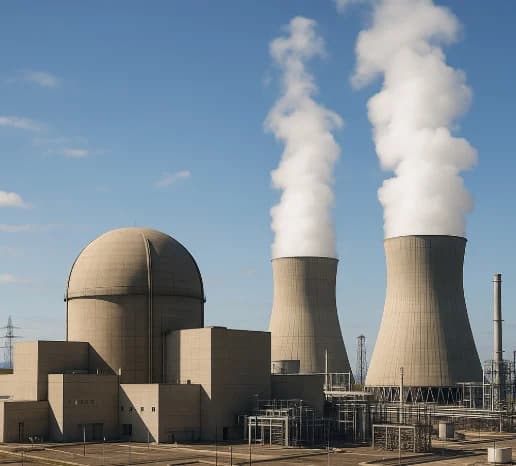
Despite the implementation of a special act aimed at fostering the small modular reactor (SMR) industry, domestic nuclear power-related stocks fell simultaneously amid wariness of a U.S.-driven interest rate shock and rising international oil prices. While the expansion of the SMR industry is emerging as a new growth axis in the long term, short-term market sentiment is being dominated by the burden of increased expectations for a U.S. base rate hike.
During intraday trading on the 15th, Doosan Enerbility traded at 85,500 won, down 1,500 won (1.72%) from the previous session. It opened at 86,400 won and rose to as high as 87,800 won before falling to 84,900 won. Woori Technology recorded a relatively large decline of 6.50% to 12,950 won, with an intraday high of 13,850 won, a low of 12,920 won, and trading volume exceeding 1.87 million shares.
Korea Power Engineering fell 2.10% to 135,300 won. Hyundai Engineering & Construction dropped 2.18% to 125,400 won, while Woojin declined 1.91% to 14,400 won. Daechang Solution fell 1.46%, Witec 1.54%, and BHI and KEPCO KPS slipped 0.62% and 0.53%, respectively. Orbitech and Bitsrotech also showed weakness, leaving a considerable number of nuclear power-related stocks in negative territory.
However, not all nuclear stocks were weak. KNR System surged 10.41% to 18,350 won, rising as high as 18,490 won intraday. S&L gained 1.08% to 2,345 won, and Wonil TNI rose 0.26% to 7,860 won.
A new policy shift has begun in the nuclear power industry itself. On the 11th, the Ministry of Science and ICT announced the implementation of the Special Act on the Promotion and Support of Small Modular Reactor Development and its enforcement decree. Enacted in March, the SMR Special Act aims to establish a government-wide support system to systematically support the research, development, and demonstration of small modular reactors and to connect technological achievements with commercialization and industrial growth.
As the government pursues the commercialization of SMRs by 2035, the focus of the domestic nuclear power industry is expanding from conventional large-scale reactors to the next-generation reactor market. In particular, the growing importance of power sources capable of stably supplying large-scale electricity amid the expansion of AI data centers and semiconductor production facilities is a mid- to long-term variable for the nuclear power industry.
On this day's stock market, however, changes in the U.S. financial market acted as a stronger short-term variable than domestic policy. In the United States, concerns about a resurgence of inflation due to rising international oil prices are sharply increasing the possibility of a Federal Reserve base rate hike. The market is placing weight on the possibility of a 0.25 percentage point rate hike at the Federal Open Market Committee (FOMC) meeting on the 15th and 16th. With the current U.S. base rate at an annual 3.50~3.75%, a 0.25 percentage point hike would raise it to an annual 3.75~4.00%.
Rising international oil prices are further complicating this outlook. If crude oil supply concerns stemming from a U.S.-Iran war push oil prices up, inflationary pressure in the United States could strengthen again. The likelihood of the Fed maintaining high rates or pursuing additional tightening to contain prices would grow accordingly.
For the nuclear power industry, rising oil prices are a double-edged factor. If fossil fuel prices such as oil and natural gas remain high for an extended period, the importance of energy security and power source diversification grows. This creates an environment in which nuclear power and SMRs could be reevaluated as stable sources of electricity. Conversely, if high oil prices stimulate inflation and lead to U.S. rate hikes, it becomes a burden on the stock market. Rising market rates increase corporate financing costs, and industries with many large-scale, long-term projects could face heavier financial cost burdens.
This is why nuclear stocks are in a complicated position. Domestically, the SMR Special Act has emerged as a long-term growth catalyst, but externally, U.S. rate hikes and rising international oil prices are simultaneously exerting pressure. In the short term, the outcome of the U.S. FOMC meeting could sway investment sentiment toward nuclear stocks. The key will be whether a rate hike actually materializes and how much room the Fed leaves for further increases going forward.
Different issues matter in the mid to long term. It must be confirmed whether the implementation of the SMR Special Act goes beyond research and development support and extends to demonstration, commercialization, and actual equipment orders and contracts. The institutional starting line toward the goal of commercialization by 2035 has been established. Market attention is now expected to shift from the policy announcement itself to whether companies participating in the nuclear power industry, such as Doosan Enerbility, Korea Power Engineering, and Woori Technology, can generate actual orders and earnings from real businesses.
[This article is general information based on the Ministry of Science and ICT's announcement and provided stock price data, and does not recommend the purchase or sale of any specific stock. U.S. interest rates, international oil prices, and government policies may change depending on future circumstances, and the final judgment and responsibility for investments rest with the investor. This article was partially assisted by AI.]
CBC Globe publishes verified stories with editorial review, source checks, and tenant-specific publication standards.
Related Articles

APR Shares Plunge Over 8%, Falling to the 220,000-Won Level... KOSPI and KOSDAQ Both Weaken
Samsung SDI Shares Fall for Second Consecutive Session to 457,000 Won as Nasdaq Plunge Dampens Investor Sentiment

Biosimilar-Related Stocks Mixed... Samsung Epis Holdings Up Over 5%, Samchundang Pharm Falls