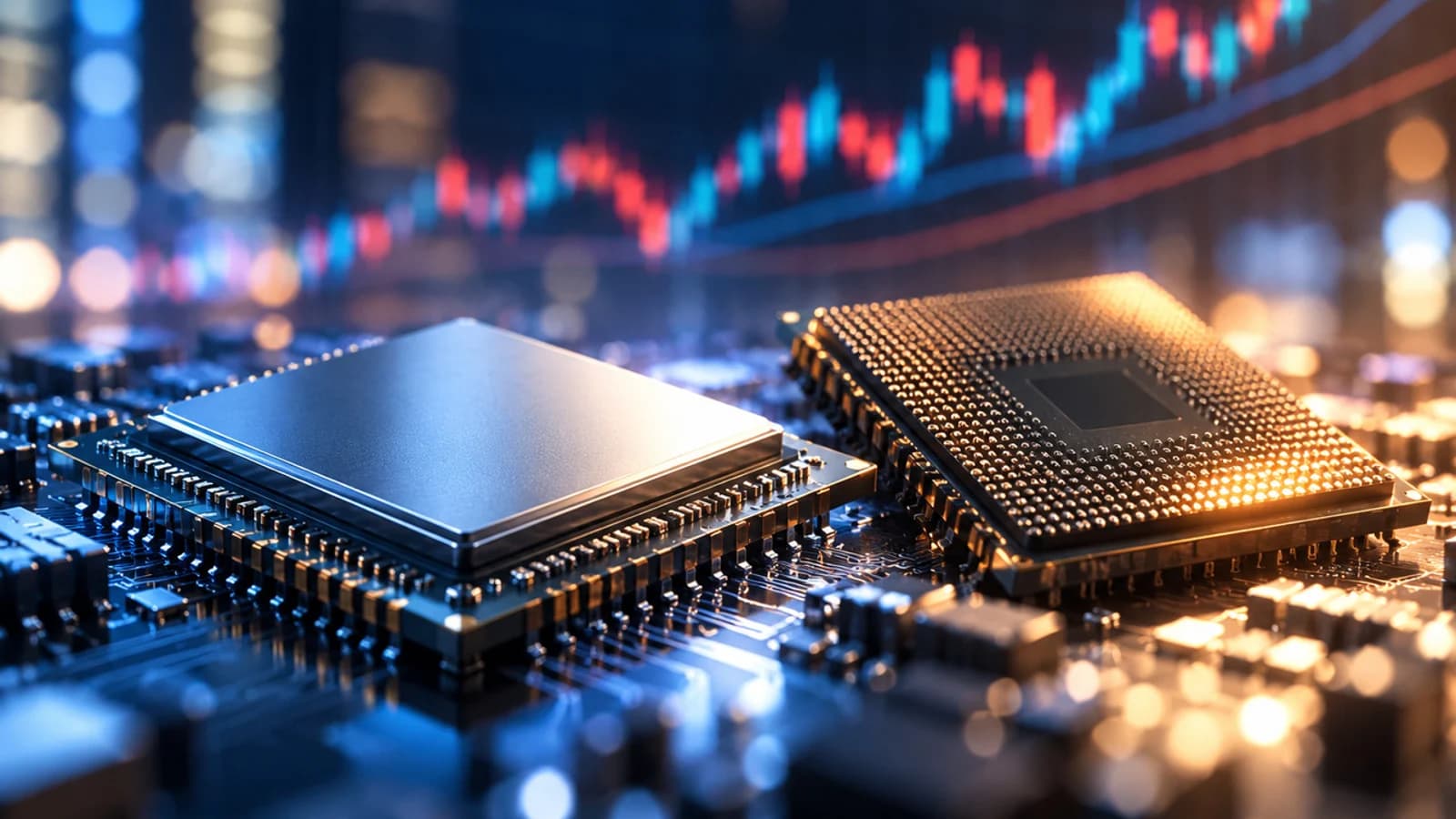
[US Stocks!Star] IonQ Achieves 1,000 Quantum Entanglements Per Second — What Is the Technology That Surpasses the Previous Record Fourfold?
IonQ (NYSE: IONQ) has achieved a new milestone in quantum computer interconnection technology. By successfully generating more than 1,000 quantum entanglements per second, the company is seen as moving a step closer to building next-generation quantum networks and large-scale quantum data centers.
![[US Stocks!Star] IonQ Achieves 1,000 Quantum Entanglements Per Second — What Is the Technology That Surpasses the Previous Record Fourfold?](/_next/image?url=https%3A%2F%2Fmedia.cbcglobe.com%2Ftenants%2Fcbc00000-0000-4000-8000-000000000001%2Fmedia%2Fcbc%2F2026%2F07%2F588503%2F14b3af78be3af851%2Foriginal.webp&w=1920&q=75)
IonQ (NYSE: IONQ) has achieved a new milestone in quantum computer interconnection technology. By successfully generating more than 1,000 quantum entanglements per second, the company is seen as moving a step closer to building next-generation quantum networks and large-scale quantum data centers.
IonQ announced on the 9th (local time) that it had achieved quantum entanglement at a rate of more than 1,000 times per second (1kHz) between ion-trap qubits and solid-state quantum memory using photonic interconnects (connection technology using photons).
Quantum entanglement is a key quantum mechanical phenomenon that allows quantum systems separated from each other to operate as a single connected system. It is regarded as an essential technology for linking multiple quantum computers into a single network.
■ Combining Ion Traps and Solid-State Quantum Memory Is Key
This achievement draws attention for combining the strengths of different quantum technologies. Ion-trap qubits excel at maintaining quantum states stably through their coherence properties, while solid-state quantum memory has the advantage of interacting efficiently with light. IonQ explained that by combining the two technologies, it achieved faster quantum connection speeds between different types of qubits than before.
The company emphasized that this achievement represents the fastest inter-platform quantum interconnect speed between qubits.
■ More Than Four Times the Previous Ion-Trap Record
Niccolo de Masi, IonQ's chairman and chief executive officer, stated, "By achieving more than 1,000 quantum entanglements per second, IonQ has passed an important milestone in memory-based quantum interconnect technology."
He added, "Just as traditional data centers evolved into large-scale systems by connecting specialized processors, memory, and networks, quantum systems will scale in a similar way," calling the breakthrough "an achievement that resolves the key connectivity bottleneck that had been blocking the scaling of quantum systems and advances IonQ's technology roadmap for building future networked quantum data centers."
Notably, the quantum entanglement rate achieved in this experiment was more than four times faster than the previous best record for the ion-trap approach.
■ End-to-End Experiment Using Silicon Vacancy Qubits, with Professor Monroe's Team Participating
According to IonQ, the research was conducted through an end-to-end quantum communication experiment connecting an ion-trap system with silicon vacancy (SiV) qubits in an actual hardware environment. Silicon vacancy qubits are a technology that leverages specific defects within diamond crystal structures and can be used to store and transmit quantum information through interaction with light. The experiment was based on the SiV-based quantum memory platform IonQ has been developing.
The previous ion-trap quantum entanglement speed record was held by the research team of Professor Chris Monroe of Duke University, a co-founder of IonQ. That team also participated as co-researchers in the technical paper on this breakthrough.
Professor Monroe serves concurrently as IonQ's chief scientist and as the Gilhuly Family Distinguished Professor at Duke University. He explained, "IonQ's quantum interconnect research began at the company's founding and has continued for more than ten years," adding, "The technology of transmitting a qubit's quantum information via photons is essential for all large-scale quantum computers." He further emphasized, "This demonstration will serve as the foundation for important research achievements to come."
■ Compatibility Not Limited to Specific Modalities, with Ties to DARPA's HARQ Program
Another reason this technology is drawing attention is that it does not apply only to a specific quantum computing modality. IonQ explained that its quantum memory and interconnect technology has a structure that can, in effect, connect with most types of qubits.
Mihir Bhaskar, senior vice president and general manager of the quantum technology division at SkyWater, said, "This research shows that photonic quantum interconnects need not be a bottleneck for distributed quantum computing," adding, "Our technology can connect with almost any type of qubit." He continued, "It could open new opportunities across a range of hardware fields, from modular quantum computing to network-based quantum sensing."
IonQ is also linking this technology to the HARQ program of the U.S. Defense Advanced Research Projects Agency (DARPA). HARQ is a program aimed at developing high-speed quantum interconnects that can link different quantum computing architectures.
Although the experiment used an ion-trap system, IonQ expects the underlying technical structure to be applicable to various quantum computing platforms, including neutral-atom and superconducting approaches. In particular, superconducting qubits can be connected to photon-based quantum networks using transducers (conversion devices) that convert microwave signals into light. This is significant in that it demonstrates the possibility of integrating quantum computers developed with different approaches into a single network.
■ From the University of Maryland to Korea's SDT, Commercialization Also Accelerating
Alongside technology development, the commercialization of the quantum memory and interconnect platform is also picking up speed. IonQ announced in April that it had sold the related system commercially for the first time to the University of Maryland, followed in September by the announcement of a second system sale to SDT, a Korean quantum technology company. Notably, the partnership with SDT is part of a strategic collaboration to jointly expand advanced quantum computing and quantum networking technologies in the Asia-Pacific region.
■ Remaining Challenges: Connection Stability, Error Management, and Scalability
This achievement shows that IonQ is expanding its business beyond improving the performance of individual quantum computers to networking technology that connects multiple quantum systems. As quantum computers grow in scale, it becomes increasingly important not only how well individual qubits perform but also how quickly and reliably quantum information can be transferred between qubits. The entanglement rate of more than 1,000 per second demonstrated by IonQ is a result that shows the potential for advancing such connection technology.
However, the experimental result does not immediately mean the completion of large-scale commercial quantum data centers. Building actual large-scale systems will require additional technical validation, including connection stability, error management, and network scalability.
Nevertheless, the fact that IonQ has demonstrated connection speeds far exceeding existing records and is pursuing commercial sales of the related systems is noteworthy for the future quantum network market. As quantum computing competition expands beyond individual processor performance to inter-system connectivity and large-scale infrastructure development, attention is focused on how IonQ's technological progress will translate into competitiveness in the future quantum data center market.
['US Stocks!Star' is overseas stock content, including U.S. stocks, provided by CBC News. We will continue striving to provide readers with a wide range of information. Please note that all investments are made at each individual's own judgment, and the final responsibility lies with the investor.]
CBC Globe publishes verified stories with editorial review, source checks, and tenant-specific publication standards.
Related Articles
HLB (028300) Closes After-Market at 46,000 Won… Hits 47,000 Won intraday but Gains Narrow

Alteogen to Absorb Merger of Alteogen Biologics on December 29... Expanding Business from Drug Development to Sales

Samsung Electro-Mechanics to Invest 6.78 Trillion Won in FCBGA Substrates for AI Servers... Expanding Production Capacity in Sejong and Vietnam