SK Chairman Chey Tae-won Stresses Problem-Solving Ability Over Academic Credentials, Offers Youth Survival Strategies for the AI Era
As artificial intelligence (AI) transforms industry and employment structures, SK Group Chairman Chey Tae-won, who also heads the Korea Chamber of Business, has pointed to problem-solving ability and a spirit of challenge as the new competitive strengths young people need. The message is for youth t
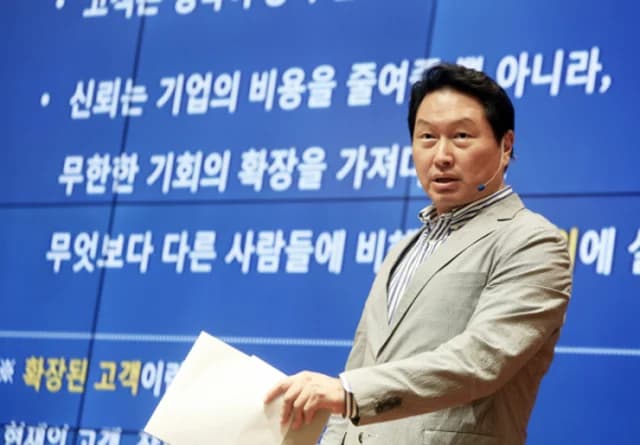
As artificial intelligence (AI) transforms industry and employment structures, SK Group Chairman Chey Tae-won, who also heads the Korea Chamber of Business, has pointed to problem-solving ability and a spirit of challenge as the new competitive strengths young people need. The message is for youth to move beyond the old model of choosing a set occupation and performing assigned tasks, and instead find problems to solve themselves and create new value.
Chairman Chey appeared on EBS's "Great Minds, Great Classes" Season 6, broadcast from the 12th to the 16th, sharing his views under the theme "AI, New Capitalism, and Youth." He was the first Korean business executive to appear on the program, delivering three lectures and two youth dialogues covering economic growth, social issues, the spread of AI technology, and the future direction of jobs and education.
Beyond corporate management, Chey has been raising topics about the future of youth and society, and his name also appears on the Netizen Awards, which reflect public interest. As of the afternoon of the 27th, he ranked 10th in the Business Leader category of the October Netizen Awards, with attention focused on how his ranking may shift in the remaining period.
■ "If I were in my 20s again, I would start a business" — urgent social problems as the starting point
Among his conversations with young people, his thoughts on entrepreneurship drew the most attention. Asked what he would choose if he were in his 20s again, Chey said without hesitation that he would start a business. However, he explained, it would not be in the semiconductor field he currently works in; instead, he would take socially urgent problems as his starting point. The areas he highlighted were challenges common to humanity, such as water and food shortages and carbon emissions. If a problem is difficult to solve with existing technology or industrial structures, he said, one could explore changing agricultural production methods or developing new foods. In effect, he approached entrepreneurship not as founding a company or generating profit, but as "a process of creating solutions society needs."
He advised young people that they do not need to set enormous goals from the start. Since problems needing solutions exist throughout society — the environment, caregiving, low birth rates, and financially vulnerable groups — he urged them to find actionable tasks in areas they care about. He also stressed that accumulated experience solving small problems can build the capacity to tackle more complex, larger-scale challenges.
■ "Eight hours of work reduced to one or two with AI" — the concept of a job is changing
The changing concept of occupations amid the spread of AI was another key topic. Chey predicted that as AI shortens work hours, individuals' ways of working and career choices will also change. Unlike the existing model of belonging to a specific company and working set hours, he explained, people may handle work efficiently with technology and spend the remaining time on other activities. If work that took eight hours a day can be done in one or two hours with AI's help, the way time is used could change as well.
These changes led to new questions about education. Chey argued that schools must move beyond delivering knowledge through a uniform curriculum and assessing achievement through exams. He believes an educational environment is needed where students gain experience finding problems themselves and experimenting with solutions. He particularly emphasized that what matters more than a university diploma or standardized evaluations may become "what actual problems you have solved."
As individual capabilities needed in the AI era, he cited four: the power of thinking, empathy, adaptability to change, and physical execution. Even if AI handles information analysis and answer generation, he said, human roles remain essential in deciding which problems to solve and collaborating with others to produce results.
He expressed similar views on leadership. He stressed the importance of distinguishing between tasks AI will perform and roles humans will take on, and of using technology to solve organizational and societal problems. Notably, he distinguished intelligence from wisdom, noting that technical capability alone cannot solve every problem. Understanding people and fostering cooperation in the process of solving problems, he explained, are essential capabilities.
He also said attitudes toward failure must change. Acting only after completely eliminating the possibility of failure makes it hard to keep pace with rapidly evolving AI technology. The point is that rather than avoiding failure, one must build the resilience to endure trial and error and try again.
■ From the SPC case to Korea-Japan cooperation — a proposal for national growth strategy
The discussion of youth careers and jobs expanded into a growth strategy for South Korea. In earlier lectures, Chey explained the potential of a new capitalism that connects solving social problems to economic activity. His idea is that measuring social performance and providing corresponding economic rewards can expand participation by companies and the private sector. As an example, he introduced the Social Progress Credit (SPC) that SK has pursued for over a decade, noting that companies receiving the incentive generated at least three times more social performance than those that did not.
As conditions for AI industrial competitiveness, he presented the "3S" framework of Speed, Scale, and Safety. He emphasized that beyond building AI infrastructure and developing technology, applying them to industry and daily life is also important, and that development must proceed in a direction that lowers social costs and improves individual lives through technology use. He also mentioned the need to transition to an "AI-native society," where citizens themselves create and use AI agents and experiment with new technologies and systems.
Regarding national growth strategy, he proposed expanding Korea-Japan economic cooperation. He explained that if the two countries cooperate at the level of an economic community, they could form a market of roughly 6 trillion dollars, citing energy, AI, healthcare, tourism, and venture and startups as cooperation fields. He emphasized that such economic cooperation could become an opportunity to expand new business opportunities, jobs, and arenas of activity for young people.
At the heart of the vision of young talent presented in these lectures lies the ability to find problems and implement solutions on one's own. The perspective is that as AI changes how work is done, the capacity to respond to new problems matters more than the amount of knowledge one possesses. Chey concluded his lecture with the message that for South Korea to grow again, a process of redesigning the nation's future is necessary, and that young people presenting new ideas and grappling with social challenges together can be the starting point of that change.
CBC Globe publishes verified stories with editorial review, source checks, and tenant-specific publication standards.
Related Articles

[C Photo] AND2BLE Performs 'French Kissing' Stage... Fatal Allure

[C Photo] Yoo Jae-pil, MC of AND2BLE's 'Sequence 02: Attraction' Showcase

Joo Woo-jae Shows 'Unexpected Chemistry' with IVE's Jang Won-young in Dessert Mukbang... Fans Say 'His Clunky Manner Feels Fresh'