76,700 Homes to Be Supplied Across 6 Seoul Metropolitan Area Sites Including Gimpo, Guri, and Hanam... Government Aims to Break Ground in 2030
The government is moving to supply a large volume of housing in key Gyeonggi Province areas bordering Seoul. On the 29th, the Ministry of Land, Infrastructure and Transport unveiled six candidate sites for new public housing districts in the Seoul metropolitan area, as a follow-up measure to the rap
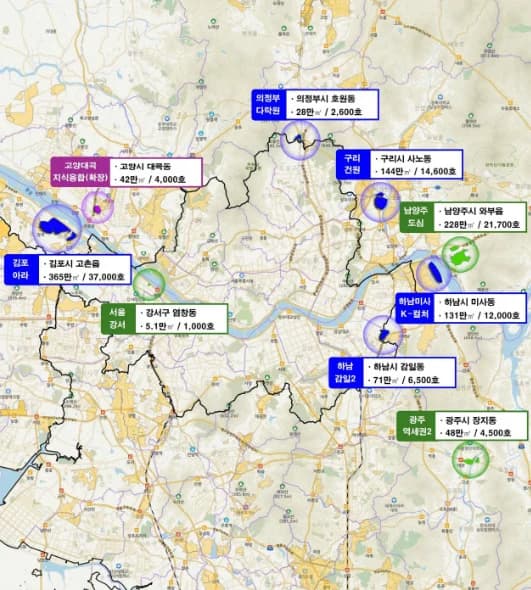
The government is moving to supply a large volume of housing in key Gyeonggi Province areas bordering Seoul. On the 29th, the Ministry of Land, Infrastructure and Transport unveiled six candidate sites for new public housing districts in the Seoul metropolitan area, as a follow-up measure to the rapid housing supply plan announced on August 13. The plan is to supply a total of 76,700 homes across six districts in five cities: Gimpo, Guri, Hanam, Uijeongbu, and Goyang. Combined with the previously announced three districts—Seoul Gangseo, Namyangju City Center, and Gyeonggi Gwangju Station Area 2—totaling 27,200 homes, the overall supply will reach about 103,900 homes. The government's plan for new housing site supply in the metropolitan area has thus secured concrete locations.
■ Accessibility to Seoul Was a Key Selection Criterion
All six selected sites are located within about 5 km of the Seoul boundary. Locations were chosen for their high accessibility to Seoul and their potential to expand housing, business facilities, and transportation infrastructure together.
The largest site is the Gimpo Ara district. About 37,000 homes will be built in this area, which is located along the Han River adjacent to Seoul's Gangseo District, and it is expected to be developed into a new residential hub for the western metropolitan area. The district can utilize Gimpo Han River Road and the Seoul Metropolitan Area First Ring Expressway, and the subway Line 5 extension project, which passed its preliminary feasibility study in March 2026, is also underway. The government plans to create a living sphere where housing and jobs develop together, in connection with existing industrial bases such as the Han River Cinepolis general industrial complex and the Gochon logistics complex.
About 14,600 homes will be supplied in the Guri Geonwon district. This area had previously been pushed as an advanced city centered on e-commerce, but the project stalled for a long period due to feasibility issues. The government has decided to shift the existing concept to a public housing-centered plan and re-launch the project. The district is close to the First Ring Expressway and allows travel to Jamsil Station in about 30 minutes. Plans under discussion include creating a residential environment utilizing waterside spaces such as Yongam Stream and Wangsuk Stream, and strengthening business and commercial functions through a review of relocating the agricultural and fisheries wholesale market.
■ Two Sites in Hanam, Plus Uijeongbu and Goyang
Two sites were selected in Hanam. The Hanam Misa K-Culture district (about 12,000 homes) is located near Misa Island and has a natural environment including the Han River and Misa Gyeongjeong Park. Subway Line 5 runs through the area, extensions of Lines 3 and 9 are being pursued, and the government plans to develop it as a complex space combined with K-culture-related facilities, nurturing it as a cultural hub for the eastern metropolitan area. The Hanam Gil2 district (about 6,500 homes) will be developed as a residential area connected to the existing Gireum district—note: the existing Gamil district—utilizing the living environment along Gami Stream leading to Olympic Park and the Han River. Plans also include establishing a public transportation system linked to the subway Line 3 extension project and wide-area transportation improvement measures for the Hanam Gyosan district, as well as reviewing improvements to the Seohanam interchange.
The Uijeongbu Dallakwon district (about 2,600 homes) includes land returned by the U.S. military's Camp Jackson. Its strengths are the natural environment of Dobong Mountain and Jungrang Stream and its proximity to Dobongsan Station, a transfer station for subway Lines 1 and 7. Living convenience facilities, sports facilities, and parks will be expanded together, developing the area into a region where housing and jobs are in harmony.
The core of the Goyang Daegok Knowledge Convergence Extension district (about 4,000 homes) is development centered on Daegok Station, where five rail lines including GTX-A and subway Line 3 connect. Unlike the existing district, which was planned mainly for the northern side of the station, this plan additionally includes part of the southern site, aiming to connect the station's surroundings into a single living sphere and create an integrated station area combining improved transfer flows with residential, business, and commercial functions.
■ Target Groundbreaking in 2030... Move-in Timing Undecided
The government has set a goal of breaking ground within 2030 by applying the shortest-term groundbreaking model for public housing land to the six districts, expediting procedures such as district designation, development planning, compensation, and permits and approvals as much as possible. However, specific move-in dates and subscription schedules are expected to be presented during the process of finalizing the project plans.
Land use and environmental issues arising from the use of greenbelt areas are also points of contention. The government explained that the candidate sites are areas damaged by existing development activities or at risk of haphazard development, and that it will bundle them into public housing districts to systematically arrange roads, parks, schools, and living infrastructure.
Responses to speculation will also be strengthened. The Ministry of Land, Infrastructure and Transport, together with the Korea Land and Housing Corporation (LH), investigated whether land was acquired using advance development information, and confirmed the land ownership of ministry and LH employees, officials in charge of related work, and their direct lineal relatives, finding no suspected cases of speculation. It reviewed 2,917 land transactions over the past three years in and around the candidate sites, selecting 654 as subjects of abnormal transaction investigations, and plans to refer cases to investigative authorities if legal violations are confirmed. Regarding land transaction permit zones, the ministry will pursue lifting designations for remaining areas, excluding those affecting newly developed regions.
Minister of Land, Infrastructure and Transport Hong Ji-sun stated that "it is important to continuously supply housing in locations preferred by groups with actual housing demand, such as young people and newlywed couples," and pledged to shorten the project procedures from district designation to groundbreaking as much as possible to increase the speed of supply.
This plan, with supply concentrated in Gimpo, Guri, Hanam, and other areas closely tied to Seoul's living sphere, is expected to significantly influence the metropolitan housing market going forward. However, for it to lead to actual housing stability, key issues include whether railway extension projects and wide-area transportation measures proceed in line with move-in timing, and whether compensation and permitting issues are resolved swiftly. Attention is also focused on whether the 2030 groundbreaking target will be met.
[Supply volumes, development plans, and groundbreaking schedules may change depending on future administrative procedures and project progress. Some assistance was provided by AI.]
CBC Globe publishes verified stories with editorial review, source checks, and tenant-specific publication standards.
Related Articles

Seoul Apartment Prices Continue Rising... Gangbuk's 14 Districts Up 0.251%, Gangnam's 11 Districts Up 0.109% (KB Real Estate Weekly Index)

Deliberate Accidents Targeting Lane Changes Account for 76%... 2,045 Traffic Accident Insurance Fraud Cases Detected, Damages Exceed 750 Million Won
'Groom's Class 2': Cho Jun-ho's Surprise Hug and GD Impression Flirting... Twin Brothers' Double Date at Folk Village to Be Revealed on the 30th