
Gold Prices Rebound on November 23... Pure Gold, 18K, 14K, Platinum, and Silver All Rise; Bitcoin ETF Outflows Also Draw Attention
According to the Korea Gold Exchange on November 23, 2026, domestic gold prices rebounded upward. Not only pure gold, 18K, and 14K, but also platinum and silver prices rose across the board, showing an upward trend throughout the precious metals market. ■ Gold, Platinum, and Silver Price Trends On
According to the Korea Gold Exchange on November 23, 2026, domestic gold prices rebounded upward. Not only pure gold, 18K, and 14K, but also platinum and silver prices rose across the board, showing an upward trend throughout the precious metals market.
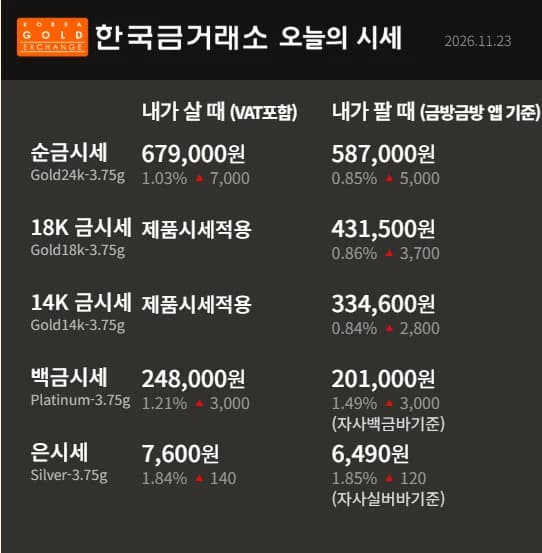
■ Gold, Platinum, and Silver Price Trends On this day, the purchase price of pure gold (24K) per don (3.75g) rose 7,000 won (1.03%) from the previous day to 679,000 won, while the selling price rose 5,000 won (0.85%) to 587,000 won.
The 18K gold selling price rose 3,700 won (0.86%) from the previous day to 431,500 won, and the 14K gold selling price rose 2,800 won (0.84%) to 334,600 won.
Platinum per don (3.75g) rose 3,000 won (1.21%) to a purchase price of 248,000 won, and 3,000 won (1.49%) to a selling price of 201,000 won.
Silver per don (3.75g) rose 140 won (1.84%) to a purchase price of 7,600 won, and 120 won (1.85%) to a selling price of 6,490 won.
■ Bitcoin ETF Outflows and Gold Prices Meanwhile, gold prices are emerging as a major focus in global financial markets. With Bitcoin moving around the $60,000 level, reports of large-scale outflows from U.S. spot Bitcoin and Ethereum exchange-traded funds (ETFs) have drawn attention to shifts in investment demand between gold and crypto assets.
The Bitcoin price shown on CoinMarketCap on the 23rd was $60,740.79, about 1.23% above $60,000.
According to data posted on the CoinMarketCap community, approximately $1.25 billion was net withdrawn from U.S. spot Bitcoin ETFs between the 16th and 20th. During the same period, about $221.7 million was reportedly withdrawn from spot Ethereum ETFs. Combined, the net outflows from the two assets' ETFs amount to roughly $1.4717 billion. However, these figures have not been verified through independent official tallies, and some data may be missing, so the final amounts could differ.
■ Gold and Bitcoin: Different Price Determinants Although Bitcoin and gold are both compared as stores of value, the factors that move their prices and their market structures differ. Gold, a traditional safe asset, is influenced by central banks' gold reserve policies, real interest rates, the dollar's value, and international geopolitical conditions. Bitcoin, by contrast, is affected by liquidity and sentiment in the crypto market, spot ETF fund flows, and derivatives trading. In particular, when risk-off sentiment in financial markets expands, gold and Bitcoin prices may move differently from each other.
However, the mere fact that funds flowed out of Bitcoin ETFs does not confirm that money is flowing into the gold market. To judge actual fund movements, the net inflows of gold spot ETFs, international gold prices, and movements in the dollar and U.S. Treasury yields must be examined together.
■ Key Variables That Determine Gold Prices U.S. monetary policy is also an important variable in determining gold prices. Since gold pays no interest or dividends, rising U.S. real interest rates can increase the relative opportunity cost of holding gold, while falling real rates can enhance gold's investment appeal.
The dollar's value also has an effect. Because the international gold market trades primarily in dollars, a stronger dollar can raise the burden of gold purchases for investors using other currencies, while a weaker dollar may create a favorable environment for gold prices.
International geopolitical conditions are also worth watching. Military tensions between the United States and Iran, geopolitical uncertainty in the Middle East, and changes in U.S.-China diplomatic and economic relations can affect risk appetite in financial markets. In particular, if military conflict in the Middle East expands, concerns over energy supply and international oil prices could grow, and if rising oil prices increase inflation pressure, U.S. interest rate expectations could shift. In such scenarios, safe-asset demand driven by geopolitical risk and rate changes driven by inflation could act on gold prices in opposing directions.
U.S.-China relations are also relevant to the gold market. The two countries' trade policies, economic cooperation, and technology-sector disputes affect global trade and financial markets. If U.S.-China relations deteriorate, market uncertainty could expand, but the actual impact on gold prices may vary depending on movements in the dollar and bond markets.
Central bank gold purchases are also significant. Central banks' expansion of gold holdings may be based on long-term policy judgments involving foreign reserve management and asset diversification, unlike short-term trading by private investors. However, central bank gold buying does not always lead to higher gold prices, and in the short term, U.S. economic indicators, rate expectations, and the dollar's value may have a greater influence on price movements.
■ Indicators for Domestic Investors Domestic gold prices are influenced not only by international gold prices but also by the won-dollar exchange rate. Even if international gold prices remain the same, a weaker won can push up domestic won-denominated gold prices, while a stronger won may mean international price gains are not fully reflected in the domestic market. Therefore, domestic investors should track both international spot gold prices and the won-dollar exchange rate.
The battle over Bitcoin's $60,000 level and U.S. spot ETF outflows serve as one indicator of global investment sentiment. However, whether funds leaving the crypto market are moving into the gold market must be confirmed through separate data.
Going forward, gold prices are expected to be influenced by multiple variables, including U.S. monetary policy expectations, international geopolitical conditions, the dollar's value, and central bank gold demand. In particular, attention is focused on whether Bitcoin can hold the $60,000 level, spot ETF fund flows, and the direction of investment demand in the international gold market.
[This article is for investment reference purposes and does not constitute a buy or sell recommendation for gold.]
CBC Globe publishes verified stories with editorial review, source checks, and tenant-specific publication standards.
Related Articles

[Breaking] U.S. October PCE Rises 3.8% Year-on-Year, Core PCE 3.3%... What Lies Ahead for Wall Street and the Fed's Rates?

Hanwha Ocean Loses Preferred Bidder Status as Thai Navy Cancels Frigate Procurement

SK Hynix to Pursue 100 Trillion Won Shareholder Returns in Fiscal 2026... Over 30 Trillion Won in Cash Dividends and More Than 60 Trillion Won in Buybacks and Cancellations