August 6, 2026 Gold Prices (Pure Gold, 18K, 14K) and Platinum & Silver Prices... Mixed U.S. Stock Market and Focus on Safe-Haven Assets
**[Domestic Precious Metals Price Trends on August 6, 2026]** According to Goldprice.com (August 6, 2026), domestic gold prices showed overall strength. * **P
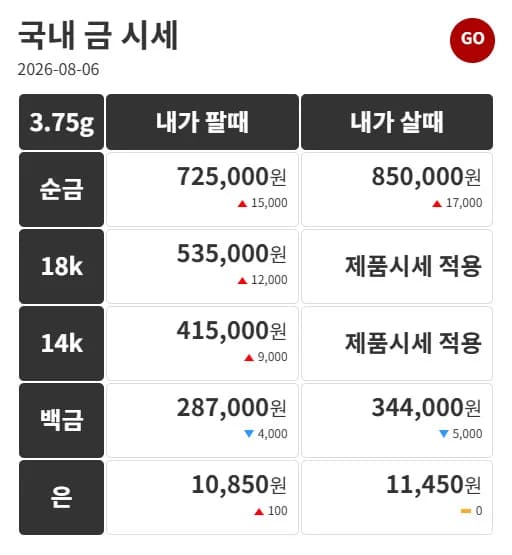
[Domestic Precious Metals Price Trends on August 6, 2026]
According to Goldprice.com (August 6, 2026), domestic gold prices showed overall strength.
- Pure Gold (3.75g): Selling price 725,000 won (up 15,000 won from the previous day), buying price 850,000 won (up 17,000 won)
- 18K: Selling price 535,000 won (up 12,000 won)
- 14K: Selling price 415,000 won (up 9,000 won)
Meanwhile, platinum showed weakness. The selling price was recorded at 287,000 won (down 4,000 won), and the buying price at 344,000 won (down 5,000 won). For silver, the selling price rose by 100 won to 10,850 won, while the buying price remained at the same level as the previous day at 11,450 won.
---
[U.S. Stock Market Mixed... Investor Sentiment on Risk Assets Divided]
On August 5 (local time), major U.S. stock market indices closed mixed, reflecting divided investor sentiment even within risk assets.
- Dow Jones Industrial Average: Driven by buying in large-cap blue-chip stocks, it closed at 54,349.00, up 263.12 points (0.49%) from the previous trading day. (Intraday high: 54,744.33, low: 54,266.12) It was the only major index to record gains.
- S&P 500 Index: Closed at 7,723.42, down 13.10 points (0.17%). Although it rose to 7,793.68 intraday, it gave up its gains and ended near the day's low of 7,720.17.
- Nasdaq Composite Index: Fell 221.55 points (0.83%) to close at 26,363.44 as profit-taking emerged in technology stocks. (Intraday high: 26,739.00, low: 26,348.51)
- Russell 2000 Index: Closed at 3,017.13, down 19.85 points (0.65%), as small- and mid-cap stocks sensitive to economic and financing conditions weakened. It rose to 3,050.30 intraday but the closing price lingered near the day's low.
The CBOE Volatility Index (VIX), which measures market volatility, was calculated at 15.81, down 0.69 points (4.18%). (Intraday high: 18.43, low: 15.48) Although stock indices were mixed, the decline in the fear index suggests that the overall market has not shifted into a phase of extreme risk aversion.
---
[The Value and Historical Significance of Gold as a Traditional Safe-Haven Asset]
When directions diverge within the stock market depending on sectors and market capitalization, investor attention sometimes shifts to traditional stores of value such as gold. Gold has been used as a means of preserving purchasing power over the long term because its value is not determined solely by corporate performance or the credit of a specific country, and its supply is limited.
The historical value of gold is closely tied to the history of money. In ancient civilizations, its rarity and unchanging nature made it a symbol of power and a decorative item, and it subsequently became a medium of exchange and a means of storing wealth. In modern times, the gold standard, which linked the value of national currencies to a fixed amount of gold, played a central role in the international financial order. In 1971, the United States suspended the convertibility of the dollar into gold, effectively ending the gold standard, and the monetary system transitioned to one based on the credit of governments and central banks.
However, the perception that gold is a physical asset that can retain its value outside the monetary system has persisted, and it remains a major holding asset for central banks and private investors. In particular, the relative value of gold is highlighted during periods of inflation, financial market instability, geopolitical conflict, and recession fears. Conversely, during periods of rising interest rates and a strong dollar, the investment appeal of gold, which does not pay interest, may weaken. Ultimately, gold prices reflect not only whether stock prices decline but also a comprehensive range of factors including interest rates, the dollar, inflation, central bank policies, and international affairs.
[Investment Considerations]
This U.S. stock market session demonstrated that investors are not evaluating risk assets uniformly, as technology and small-cap stocks declined despite the Dow's gains. While there is no immediate surge in fear, continued differentiation among indices could renewed attention on gold's role as a means of diversifying assets.
However, gold is also an investment asset subject to price fluctuations, so the label "safe-haven asset" does not mean there is no possibility of a price decline. When evaluating gold-related investments, one should consider not only international gold prices but also the won-dollar exchange rate, U.S. Treasury yields, the dollar index, and the monetary policies of various central banks.
[※ This article is not intended to solicit investment, and all investment decisions and responsibilities lie with the investor.]
CBC Globe publishes verified stories with editorial review, source checks, and tenant-specific publication standards.
Related Articles
Vitze Nextech Signs 53.5 Billion Won 'Nuri' Engine Component Supply Contract with Hanwha Aerospace
![[Breaking] CrowdWorks Acquires 4.8% Stake in Daeyang Metal for KRW 11.9 Billion... "Joint Management System Launched"](/_next/image?url=https%3A%2F%2Fmedia.cbcglobe.com%2Ftenants%2Fcbc00000-0000-4000-8000-000000000001%2Fmedia%2Fcbc%2F2026%2F06%2F581748%2Fed2a73c31f2e2200%2Fvariants%2Fhero.webp&w=1920&q=75)
[Breaking] CrowdWorks Acquires 4.8% Stake in Daeyang Metal for KRW 11.9 Billion... "Joint Management System Launched"
HEM Pharma Resolves to Issue 54 Billion Won Private CB... to Raise Funds for Facility Investment and Operations