Democratic Party Leadership Race 'Jung Cheong-rae vs. Kim Min-seok' Goes Down to the Wire... Negative Campaigning Intensifies Amid 1-Percentage-Point Gap
The leadership race at the Democratic Party's August 17 national convention is heading into a nail-biting finish. Candidate Jung Cheong-rae and Candidate Kim Mi
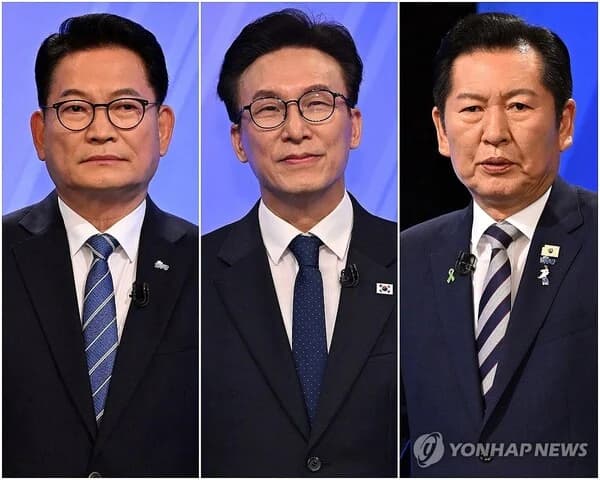
The leadership race at the Democratic Party's August 17 national convention is heading into a nail-biting finish. Candidate Jung Cheong-rae and Candidate Kim Min-seok are locked in a tight contest, separated by a margin of around one percentage point.
Major media outlets reported that Jung is maintaining a narrow lead based on the voting results from party members with voting rights in the Chungcheong region and the Busan-Ulsan-Gyeongnam area. The Chosun Ilbo reported that Jung holds a lead of 1,211 votes, or one percentage point, while the JoongAng Ilbo and Maeil Business Daily also analyzed the race as a photo finish within a one-percent margin.
The key variables that will determine the outcome are the voting results from the Honam region and the Seoul metropolitan area. This is because 32.9% of all party members with voting rights are concentrated in South Jeolla, Gwangju, and North Jeolla, while 38.3% are in Seoul and Gyeonggi.
Competition between factions is also fierce in the supreme council member race. Pro-Lee (Jae-myung) faction candidate Kim Yong (12.41%) and pro-Jung faction candidate Lee Seong-yoon (11.34%) are in a tight race for the fifth and final elected seat, separated by a 1.08-percentage-point gap. Observers say the factional makeup of the supreme council could change depending on how votes are distributed. The pro-Jung faction is simultaneously aiming for candidate Choi Min-hee's ascension to the position of senior supreme council member and candidate Lee Seong-yoon's entry into an elected seat, but if votes are split, there is a possibility that the senior position could go to second-place candidate Park Seon-won. The pro-Lee faction also faces complex calculations, needing to defend candidate Kim Yong while concentrating votes on candidate Park Seon-won.
■ 'Those Who Betray Once Will Betray Again'... Negative Campaigning Intensifies
Negative campaigning among candidates has also intensified during the convention process. Candidate Jung Cheong-rae criticized rival Kim Min-seok by raising his history of leaving the party, saying, 'Those who betray once will betray again.' Candidate Kim fired back at Jung, saying, 'After President Lee Jae-myung's inauguration, there was a conflict within the ruling party known as the Myung-Cheong showdown.'
As mutual attacks continued, including allegations of mass Shincheonji recruitment and threats of ethics committee referrals, cases of candidates reporting each other to the party's election committee also emerged. Jung demanded an apology from the election committee over a cautionary and corrective order issued against him and called for fair standards to be applied to Kim as well.
Factional conflict has spread to the supreme council. Pro-Lee faction Supreme Council Member Kang Deuk-gu criticized candidate Jung Cheong-rae, saying, 'A candidate who repeats lies is unqualified,' and publicly rebutted Jung's remarks referencing the president's intentions. Pro-Jung faction Supreme Council Member Park Kyu-hwan targeted candidate Kim Min-seok, saying, 'The party responded passively to the candidate who promoted the Shincheonji involvement theory,' and called for stern disciplinary action if allegations of disseminating false information and illegal electioneering are raised. Senior lawmakers within the party also expressed concern that remarks, including threats of ethics committee referrals, had crossed the line.
Exchanges between supreme council member candidates continued during TV debates and public events. Candidate Kim Yong criticized the previous leadership under Jung Cheong-rae for shifting blame for the local election defeat onto the government, while pro-Jung faction candidate Han Min-soo took issue with former Prime Minister Kim Min-seok's nationwide tour.
■ Blame Game Over Samtechnix ETF and Abolition of Supplementary Investigation Rights
A blame game among candidates also erupted over the introduction of a single-stock leveraged ETF for Samtechnix (Samsung Electronics and SK Hynix) and the delay in abolishing prosecutors' supplementary investigation rights. Candidate Jung Cheong-rae held Kim accountable, pointing out that the legislative notice for the leveraged ETF introduction was issued and passed through the State Council during Kim's tenure as prime minister. Candidate Kim pledged to come up with countermeasures by expanding the party's K-Capital Market Special Committee. Candidate Song Young-gil also joined the debate, addressing the role of the ruling party leader.
Regarding the delay in processing the revised Criminal Procedure Act to abolish supplementary investigation rights, Jung pointed to the government's lukewarm attitude while Kim pointed to the opposition of Jung's leadership to the May revision bill, as they traded criticism and attempted to shift responsibility onto each other.
■ Unified Voice on Real Estate Policy... Supply Expansion and Financial Deregulation
On real estate policy and tax reform, all three candidates broadly agreed on expanding housing supply and easing financial regulations for actual homebuyers. They also presented specific measures, including developing countermeasures to address the phenomenon of properties being locked off the market and concerns over declining jeonse and wolse (lease and monthly rent) rates, lifting greenbelt restrictions, and relaxing real estate project financing regulations.
CBC Globe publishes verified stories with editorial review, source checks, and tenant-specific publication standards.
Related Articles

600 Billion Won Invested as Pohang AI Data Center Kicks Off in Earnest... 'Operations to Begin in First Half of 2028'

Lee Kang-in Set for First Match in Atletico Jersey... Named to 27-Man Squad for Coupang Play Series
13th Jeju Samdasoo Masters Opens... KLPGA Goes All Out on Safety Amid Heatwave Concerns