
From King Jeongjo's 60th Birthday Banquet for 6,300 People in Suwon to the 'Minister-Restricted Tyrant' Drinking Discussions... 'What Did the King Eat?'
King Jeongjo's filial piety and love for the people, which drove the cultural renaissance of Joseon, were highlighted on TV CHOSUN's "What Did the King Eat?" Th
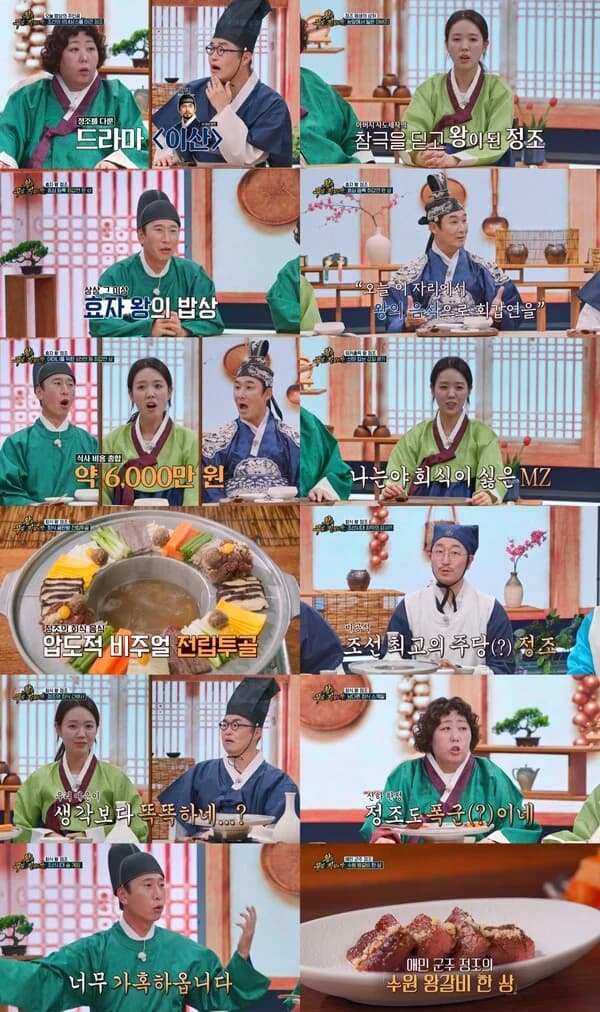
King Jeongjo's filial piety and love for the people, which drove the cultural renaissance of Joseon, were highlighted on TV CHOSUN's "What Did the King Eat?"
The program, which aired on the 5th at 10 PM, primarily focused on the large-scale 60th birthday banquet held in Suwon to commemorate the birthday of Jeongjo's father, Crown Prince Sado, as well as the unique after-work dining culture Jeongjo shared with his ministers.
To celebrate the 60th birthday of his father, Crown Prince Sado, who was the same age as his mother, Lady Hyegyeong of the Hong clan, Jeongjo organized a procession spanning approximately 1 kilometer. This Suwon event, which saw a staggering 6,300 participants, lasted for eight days and featured 315 different dishes on the banquet table. The lavish feast, equivalent to approximately 60 million won by today's standards, included dishes such as "byeoljaptang," a soup made with delicacies from land and sea; "gilgyeong japchae," a dish using bellflower root; and "hwahyangjeok," a colorful skewered dish.
During the broadcast, the "after-work dining culture" that Jeongjo established to relieve the fatigue of his ministers after setting up the Gyujanggak Royal Library for talent cultivation was also introduced with great interest. In particular, "jeollipgugol," a dish in which broth and various ingredients are boiled in a brazier shaped like a military hat, was highlighted as a representative menu item. Cast members Yang Sang-guk, Shin Gyi-ru, and Ji Ye-eun praised the dish, saying it was "ideal for sharing and building friendships." Choi Tae-sung explained that while Jeongjo was strict during working hours, he was proactive and bold at dining gatherings.
Jeongjo's unconventional drinking party persona was also revealed. He advocated the toast "Bulchwi Mugu," and imposed penalties on his ministers, such as composing poems within a time limit. Strict rules even existed, including exile for those who failed to compose a poem. He even gave playful orders to pour strong royal soju, reaching 60 to 70 degrees, into brush holders for drinking. Regarding this, Yang Sang-guk described him as a "minister-restricted tyrant," and Jeong Yak-yong, a minister at the time, reportedly expressed his agony, saying, "I am going to die today."
Meanwhile, foods embodying Jeongjo's love and concern for the common people also drew attention. During the construction of the Hwaseong Fortress in Suwon, Jeongjo implemented a system in which cows were lent to the people free of charge and repaid with calves. As a result, Suwon was able to grow into one of the top three cattle markets in Joseon, and this became the catalyst for the creation of Suwon's famous "Wang Galbi" (royal ribs). Additionally, kkakdugi, originating from "gakdokgi," a royal court food developed by Jeongjo's daughter, Princess Sukseon, was also served on the banquet table. Upon tasting it, Shin Gyi-ru exclaimed, "I am so surprised," and could not hold back her admiration for the taste of Wang Galbi.
In the next broadcast, the dining table of Danjong, the tragic "boy king" of the Joseon Dynasty, will be explored alongside mountaineer Um Hong-gil.
CBC Globe publishes verified stories with editorial review, source checks, and tenant-specific publication standards.
Related Articles

600 Billion Won Invested as Pohang AI Data Center Kicks Off in Earnest... 'Operations to Begin in First Half of 2028'

Lee Kang-in Set for First Match in Atletico Jersey... Named to 27-Man Squad for Coupang Play Series

13th Jeju Samdasoo Masters Opens... KLPGA Goes All Out on Safety Amid Heatwave Concerns