
Goldman Sachs: "KOSPI at 12,000 Points Within a Year"… Sharp Decline Judged as "Correction Within a Bull Market"
Goldman Sachs Reaffirms KOSPI 'Overweight'… "92% Additional Upside Potential" Despite the KOSPI market experiencing significant volatility, including a decline
Goldman Sachs Reaffirms KOSPI 'Overweight'… "92% Additional Upside Potential"
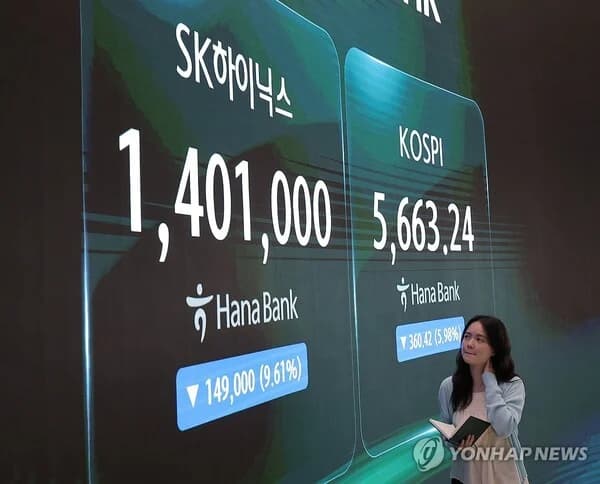
Despite the KOSPI market experiencing significant volatility, including a decline of approximately 39% over the past month, global investment bank Goldman Sachs has maintained its existing target of the KOSPI reaching 12,000 points within 12 months. Goldman Sachs analyzed that the market is reflecting overly negative expectations compared to actual fundamentals, interpreting the recent sharp decline not as a secular bear market but as a correction within a bull market.
Goldman Sachs strategists, including Timothy Moe, reaffirmed their 'overweight' rating on the KOSPI in a report released on the 4th (local time). They stated that considering the KOSPI closed at 6,296.38 points on the 6th, there is approximately 92% additional upside potential. The target presented by Goldman Sachs is 12,000 points, a figure significantly above the current level.
Sharp Decline and Rebound… "Similar to Correction Phases Over the Past 20 Years"
The report specifically highlighted the recent sharp movements in the KOSPI. After surging 116% since the beginning of the year to reach an all-time high of 9,114.55 on June 22, it dropped to 5,593.56 on July 30. Subsequently, on July 31, it rebounded 17.91% in a single day, recording the largest daily gain in history.
Goldman Sachs assessed that this sharp decline and rebound are similar to other downturn phases experienced over the past 20 years, including the 2021 tech stock correction, the COVID-19 pandemic, and the 2011 correction.
Concerns about the semiconductor memory cycle were cited as the primary cause of the decline. Additionally, technical factors typically seen as overheating signals—such as leveraged exchange-traded fund (ETF) selling, movements by short-term momentum-following investors, and the relative strength index (RSI) exceeding 80—were diagnosed as factors that amplified the drop.
Semiconductor Memory Outlook: "This Cycle Will Be Longer and Stronger Than in the Past"
Goldman Sachs maintained a positive view on the semiconductor memory sector. Based on increasing computing demand and projections of supply shortages that could persist through 2030, the bank forecast that this memory cycle will be longer and stronger than previous ones. Accordingly, it pointed out that pricing power and profitability are not fully reflected in market prices. Major domestic companies such as Samsung Electronics and SK Hynix are expected to continue benefiting from this boom in the memory market.
While concerns exist regarding hyperscaler capital expenditures (CapEx), capital market fundraising, and intensifying competition, these factors were assessed as not fundamentally undermining the long-term bullish scenario.
Stable Supply-Demand + Non-Memory Outlook + Governance Reform
The supply-demand environment was also analyzed to have improved. Net assets of leveraged ETFs have shrunk and margin trading exposure has been reduced. Market positioning has stabilized compared to the past due to tightened regulations and reduced hedge fund exposure.
The outlook for the non-memory sector, which accounts for 40–50% of the total market capitalization, is also positive. Operating profits are projected to increase by 71% and 20% this year and next year, respectively, with valuations remaining low on both an absolute and relative basis. It was also noted that corporate governance reforms continue to make steady progress.
"Risk-Reward Structure Is Favorable… Achieving Target Requires Only a PER of 7.8x"
Overall, Goldman Sachs evaluated the market's risk-reward structure as favorable. With earnings projected to grow by 320%, 35%, and 20% in 2026, 2027, and 2028, respectively, the current price-to-earnings ratio (PER) stands at 5.1x, meaning that an improvement in valuation to 7.8x is all that is needed to achieve the target. This remains a low level compared to previous market peaks.
Finally, Goldman Sachs presented AI-related stocks such as semiconductors and power equipment, along with defense, shipbuilding, financials, construction, department stores, holding companies, and preferred shares as favored sectors for its investment strategy. Additionally, stocks with a buy rating from its own analysts and a knock-in risk reversal option strategy that activates under specific conditions were mentioned as concrete response measures.
CBC Globe publishes verified stories with editorial review, source checks, and tenant-specific publication standards.
Related Articles

KBS 2TV 'Love Is on Its Way' Kim Mujin and Han Gyurim Reunite at a Police Station After 8 Years Following an Unexpected Accident... Cold Gazes ('Episode 4')

Ji Seung-hyun and Young-tak Collaborate on 'Hard Tteokbokki'... Air Fryer Cooking and Fortune Reading on 'Convenience Store Restaurant'

Nonghyup Mobilizes to Minimize Heatwave and Drought Damage... 5,900+ Cooling Shelters in Operation and Field Recovery Support Strengthened
