
Chae Sang-bae Inaugurated as 18th President of KAIST... Declares Five Strategies Including Building an 'AI Native Campus'
KAIST is fully launching the establishment of an 'AI Native Campus' that introduces artificial intelligence (AI) across all aspects of the university, including education, research, and administration. The goal is to leap forward as a 'national innovation platform' by fostering talent equipped with
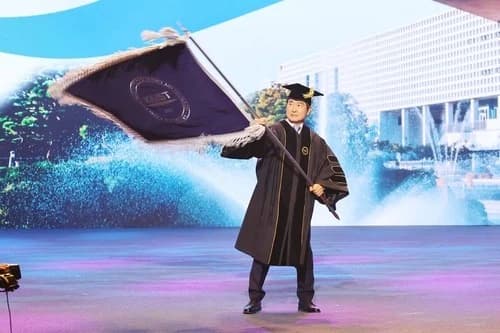
KAIST is fully launching the establishment of an 'AI Native Campus' that introduces artificial intelligence (AI) across all aspects of the university, including education, research, and administration. The goal is to leap forward as a 'national innovation platform' by fostering talent equipped with both foundational academic skills and AI capabilities, as well as by expanding global entrepreneurship.
This vision was officially declared at the inauguration ceremony of the 18th President, Chae Sang-bae, held on the morning of the 10th at the KAIST Main Auditorium.
Eco-Friendly Energy Expert, New President Chae Sang-bae Incoming President Chae Sang-bae graduated from the Department of Aerospace Engineering at Seoul National University and earned his Ph.D. in Mechanical Engineering from Imperial College London in the UK. He is an expert in the fields of eco-friendly energy and carbon-neutral power engineering. Since joining KAIST in 1998, he has served as the Head of the Department of Mechanical Engineering, Dean of the College of Engineering, and Head of the Science and Technology New Deal Task Force for COVID-19 Response.
The inauguration ceremony was attended by domestic and international figures, including Deputy Prime Minister and Minister of Science and ICT Bae Kyung-hoon, former President Lee Kwang-hyung, and ambassadors of major countries to South Korea, who celebrated the new beginning. The event was also broadcast live through KAIST's official YouTube channel.
"A Global Leading Innovation University with Strong Fundamentals" In his inaugural address, President Chae emphasized 'continuity and innovation' as the core philosophy of university operations. He expressed his commitment to inheriting the values of creativity, challenge, and care that KAIST has accumulated over the past 55 years, while also pursuing comprehensive innovation across the university in response to the great AI transition and global technological hegemony competition.
He declared a new vision of becoming "a global leading innovation university with strong fundamentals," explaining that the university will realize world-class education, research, entrepreneurship, and internationalization based on talented individuals and an organization with solid foundations.
- To achieve this, KAIST will promote five development strategies under the banner of 'Beyond':
- Beyond AI: AI for Everyone
- Beyond Laboratory: Innovative Research and Entrepreneurship
- Beyond Barriers: An Efficient and Open University
- Beyond Carbon: Eco-Friendliness and Sustainability
- Beyond KAIST: To the World and the Future
From Physical AI to the Agentic AI Era KAIST plans to expand AI not as a specific major, but as a common language and universal tool across all disciplines, focusing on fostering designers of human-centric autonomous systems. The university will expand humanities and social science education as well as hands-on lab training, nurturing talents who combine strengthened basic academic skills, such as mathematics, with AI capabilities to become 'AI warriors' and global innovators.
In line with the trend of AI expanding into 'Physical AI' that operates in the real world—such as robotics, autonomous driving, and advanced manufacturing—KAIST will establish a balanced education and research system. Furthermore, by introducing an AI-driven educational innovation model, the university will realign its curriculum and assign AI utilization grades to all courses, stepping up to cultivate talent that will lead the 'Agentic AI' era.
In the areas of research and entrepreneurship, KAIST will expand the recruitment of industry-affiliated satellite labs and collaborative research centers. It will also push to establish an 'AI Autonomous Lab' that integrates AI into joint R&D with companies. Specialized entrepreneurship education for freshmen and a practice-oriented startup education innovation model involving alumni and field experts will also be prepared. By strengthening carbon-neutral technology research, ESG management, and the implementation of SDGs (Sustainable Development Goals), the university plans to transform the campus into a living lab for a climate-responsive smart city.
As for administrative innovation, an AI-based digital one-stop administrative system will be introduced to automate repetitive tasks, supporting professors and students to focus on research and education. Barriers between departments will be lowered to encourage convergent research, and incentives will be provided to staff who drive AI innovation. The internationalization strategy includes promoting joint degree programs, involving foreign distinguished scholars in dissertation reviews, forming a global advisory board, and attracting international joint research and global deep-tech companies.
Aspirations to Become a World-Class University by the 60th Anniversary Referring to his own research experience, President Chae emphasized that "AI technology has made a quantum leap compared to the time about 20 years ago when I developed engine control technology using Artificial Neural Networks (ANN)." He further expressed his ambition, stating, "We will realize many dreams by the 60th anniversary of our founding in 2031," and adding, "We will return the benefits received from the country many times over and grow KAIST into a world-class university."
Meanwhile, breaking away from the traditional one-way congratulatory speech format, this inauguration ceremony featured President Chae directly presenting the university's operational philosophy and future vision on stage. During the event, cases were introduced, including a digital twin for the shipbuilding sector by Dr. Yoon Hyun-sook of HD Korea Shipbuilding & Offshore Engineering, and the application of AI in the semiconductor production process by Dr. Shin Ji-yong of the Samsung Electronics Semiconductor Research Institute. KAIST Professor Hwang Jun-sik explained the direction of Physical AI development in the automotive, mobility, and robotics sectors. Additionally, a humanoid and a quadruped walking robot appeared on stage during the event to deliver a performance.
CBC Globe publishes verified stories with editorial review, source checks, and tenant-specific publication standards.