
K2 Tank Upgrade Project Kicks Off in Earnest... KRW 3.448 Trillion Invested, Active Protection System and Drone Jammer to Be Installed
Major upgrade projects representing the domestic defense industry, including the K2 tank and the Ship-to-Ship Missile-II, will be pursued in earnest. The competitiveness of the K2 tank, which gained global attention following its export to Poland, is expected to be further strengthened. The Defense
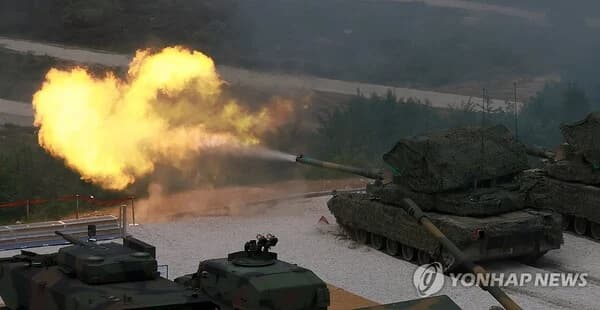
Major upgrade projects representing the domestic defense industry, including the K2 tank and the Ship-to-Ship Missile-II, will be pursued in earnest. The competitiveness of the K2 tank, which gained global attention following its export to Poland, is expected to be further strengthened.
The Defense Acquisition Program Administration (DAPA) announced that the 177th Defense Acquisition Program Committee meeting, held at the Ministry of National Defense on the 11th, deliberated and approved the basic strategies for the K2 tank upgrade and the Ship-to-Ship Missile-II projects.
■ K2 Tank Upgrade: KRW 3.448 Trillion to KRW 3.45 Trillion Invested
Approximately KRW 3.448 trillion to KRW 3.45 trillion will be invested in the K2 tank upgrade project from 2028 to 2046. Military requirements were finalized in the first half of this year, with system development scheduled to be completed by 2032 and sequential deployment starting in 2033.
The core of this upgrade lies in building a 'multi-layer protection system' that detects, disrupts, and intercepts threats, going beyond simple armor reinforcement. The most notable change is the new integration of a hard-kill Active Protection System (APS). While the existing K2 was only equipped with a soft-kill system for disrupting missile guidance, this upgrade will add a hard-kill system.
Additionally, a Remote Controlled Weapon System (RCWS) armed with a 12.7mm machine gun, as well as jammers for drones and improvised explosive devices (IEDs), will be incorporated. The jammer disrupts radio signals to block the approach and detonation of drones and remotely controlled explosives, while the RCWS allows the crew to respond to close-range threats from inside the vehicle. This will drastically improve survivability against future battlefield threats such as anti-tank missiles and suicide drones.
Meanwhile, North Korea is also enhancing its conventional forces by applying an active protection system to its new main battle tank, the 'Chonma-2,' making the security implications of this K2 upgrade even more significant.
■ Indigenous APS vs. Israel's 'Trophy'... Strengthening Export Competitiveness
The K2 upgraded variant will be equipped with a hard-kill APS developed with domestic technology. In contrast, the K2PL, the export version for Poland, will be fitted with Israel's Rafael 'Trophy' APS, along with drone jammers, an RCWS, and special armor.
DAPA explained that securing an indigenous APS holds significant importance for both military operational capability and defense exports. Reducing reliance on foreign systems allows for more flexible configuration of protective equipment tailored to the needs of importing countries, while also mitigating export approval constraints and supply chain limitations from third-party nations.
■ Ship-to-Ship Missile-II: Double the Range, KRW 1.63 Trillion Budget
A budget of approximately KRW 1.63 trillion has been allocated for the Ship-to-Ship Missile-II project from 2028 to 2039. The goal is to domestically develop and secure a stealth-type ship-to-ship missile with more than double the range of the existing Haeseong-I (range of approximately 150 km).
System development will take place from 2028 to 2033, with mass production beginning in 2034. Once development is complete, the missiles are slated to be deployed on new domestic vessels, such as the Korean Next-Generation Destroyer (KDDX).
DAPA projected that the acquisition of the Ship-to-Ship Missile-II will significantly enhance the military's ability to counter maritime threats. Furthermore, the ability to export domestic vessels and weapons as a package will reduce the burden of weapons system integration and further strengthen export competitiveness.
CBC Globe publishes verified stories with editorial review, source checks, and tenant-specific publication standards.
Related Articles
![[Weather] Typhoon Chanhom Makes Landfall in Southern Ibaraki Prefecture, Japan — First Since 1951](/_next/image?url=https%3A%2F%2Fmedia.cbcglobe.com%2Ftenants%2Fcbc00000-0000-4000-8000-000000000001%2Fmedia%2Fcbc%2F2026%2F08%2F597416%2F6a086d68706f9587%2Fvariants%2Fhero.webp&w=1920&q=75)
[Weather] Typhoon Chanhom Makes Landfall in Southern Ibaraki Prefecture, Japan — First Since 1951
Colombia Hit by Largest 'Magnitude 7.4' Earthquake of the 21st Century: 164 Dead, 188 Missing

"Because We Have Different Blood Types..." Jun Hye-won, the Shocking Secret of Birth Revealed by a School Fire Accident