
State-run Bank Unions Hold First Joint Rally Against Relocation to Regions... "Policy Finance Will Be Paralyzed"
As the government's second-phase plan to relocate public institutions to regional areas gains momentum, the labor unions of the three major state-run banks held a rally to squarely oppose the move. An unofficial police estimate put the turnout at the first large-scale joint rally, held on May 11 in
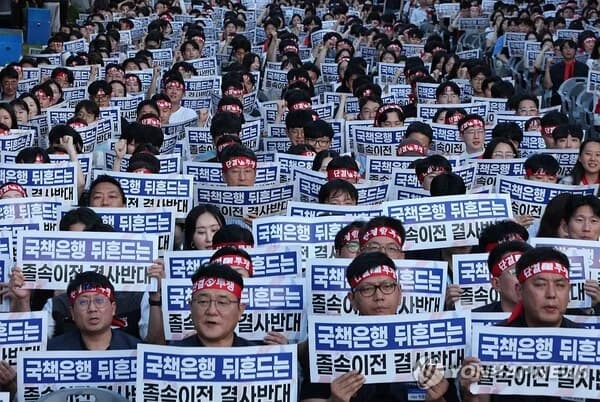
As the government's second-phase plan to relocate public institutions to regional areas gains momentum, the labor unions of the three major state-run banks held a rally to squarely oppose the move. An unofficial police estimate put the turnout at the first large-scale joint rally, held on May 11 in Yeongdeungpo-gu, Seoul, at approximately 2,000 people.
Fierce Competition Among Local Governments... Bid to Attract Financial Institutions Begins in Earnest
The Ministry of Land, Infrastructure and Transport and the Korea Research Institute for Human Settlements are currently reviewing candidate sites for the relocation of some 350 institutions, with a concrete outline expected as early as next month. On the 3rd, the city of Busan held a task force meeting chaired by Mayor Park Heong-joon to promote the relocation of public institutions, selecting financial institutions such as the Korea Development Bank (KDB), Industrial Bank of Korea (IBK), Korea Export-Import Bank (KEXIM), and Korea Trade Insurance Corporation as targets for attraction. The city of Daegu has also made attracting the IBK headquarters its top priority, emphasizing linkages with regional small and medium enterprises and the Korea Credit Guarantee Fund in the Daegu Innovation City. Multiple local governments, including South Gyeongsang Province and North Chungcheong Province, are also targeting IBK, intensifying the competition.
As the relocation plan becomes more tangible, the state-run bank unions have formed a joint response task force involving nine branches to share information on regional relocation candidates, local governments, and political developments, thereby strengthening their opposition.
"Burden on Accessibility and Securing Expertise"... Reasons for Union Backlash
The unions of the three major state-run banks — KDB, IBK, and KEXIM — argue that relocating their headquarters could impose burdens on operational efficiency and the recruitment of specialized personnel, citing the unique nature of policy financial institutions. They maintain that since KDB handles industrial and corporate finance and restructuring, IBK oversees finance for SMEs and small business owners, and KEXIM is responsible for export and foreign financial operations, accessibility to the government, corporations, and financial firms is essential. There is also precedent: in 2023, KDB was designated as a public institution to be relocated to Busan, but its headquarters remained in Seoul because the Korea Development Bank Act was not amended.
First Joint Rally on the 11th... Around 2,000 Attendees
As discussions on regional relocation pick up speed, the three state-run bank unions held a "Rally to Resolve All-Out Struggle to Stop the Relocation of State-Run Banks to Regions" at 7 p.m. on May 11 along Uisandang-daero next to the KDB headquarters in Yeongdeungpo-gu, Seoul. This was the first large-scale event jointly organized by the state-run bank unions, and officials from the Korean Financial Industry Union and the Korean Confederation of Trade Unions also participated. Participants filled a 200-meter stretch in front of the main stage, holding picket signs and banners reading, "Decisively oppose the hasty relocation that shakes state-run banks," "You can change the address, but you cannot move the expertise," and "You cannot move the talent, and you cannot shake state-run banks." A diverse group of attendees gathered, from employees in suits on their way home from work to workers in group t-shirts.
They criticized the relocation of state-run banks as "hasty administration" under the guise of regional development, arguing that it is being pursued without sufficient review of its potential impact on the national economy.
Union Leaders and Members Appeal in Turn
Lee Jang-hee, head of the IBK branch, claimed that commitments made during the presidential election — regarding the distinctiveness of state-run banks, the creation of a Seoul financial hub, and a scientific review of the side effects of the first-phase relocation — are being ignored. Jung Eun-joo, head of the KEXIM branch, emphasized that state-run banks are "geese that lay golden eggs," paying over 2 trillion won in dividends annually, and must remain in Seoul to serve as a safety net during national crises. Kang Ji-sung, deputy head of the KEXIM branch, pointed out that finance is fundamentally about trust and networks, and that the overseas network assets built over 50 years cannot be replicated overnight through a headquarters relocation. An assistant manager-level KDB member mentioned colleagues leaving due to job insecurity and lamented the reality of having to repeat the same fight every time the administration changes. An IBK member who is newlywed appealed that his housing, family, and future plans are being upended, stating that pushing forward with a relocation without consultation is destroying workers' lives.
Lawmakers Also Attend... "Concerns Over Negative Impact on National Economy"
Rep. Kim Hyun-jung of the Democratic Party pointed out that major countries such as the United States, the United Kingdom, and Japan are clustering core financial functions, and argued that revitalizing regional economies depends not on relocating state-run banks but on creating an environment where local businesses can receive timely funding. Han Chang-min, leader of the Social Democratic Party, criticized the government for pushing ahead hastily without labor-government consultations, despite the issue affecting the lives of some 20,000 workers, their families, and hundreds of thousands of others. He pledged to scrutinize the matter closely and show solidarity at the level of the National Assembly's Political Affairs Committee, citing inconsistent approaches such as shifting positions from the Ministry of Land, Infrastructure and Transport and a gag order from Yongsan.
At the end of the rally, the three branch heads took the stage for a performance in which they smashed acrylic boards with a hammer, bearing phrases such as "paralysis of state-run bank functions," "deception over regional development," and "oppressive forced relocation." This was followed by the reading of a resolution urging the government to reconsider its policy direction, arguing that unilateral and uniform relocation at a time when policy finance needs to be expanded for national future industries such as semiconductors and AI would weaken the competitiveness of financial hubs and cause negative side effects across the national economy. The unions stated that starting with this rally, they plan to consider a general strike depending on the government's future decisions.
CBC Globe publishes verified stories with editorial review, source checks, and tenant-specific publication standards.
Related Articles
![KIA Defeats Samsung 3-1... Lee Eui-ri Earns First Career Save, Adam Oler Reaches 10 Wins [KBO Review]](/_next/image?url=https%3A%2F%2Fmedia.cbcglobe.com%2Ftenants%2Fcbc00000-0000-4000-8000-000000000001%2Fmedia%2Fcbc%2F2026%2F08%2F597503%2Fc48c7cf91b977196%2Fvariants%2Fhero.webp&w=1920&q=75)
KIA Defeats Samsung 3-1... Lee Eui-ri Earns First Career Save, Adam Oler Reaches 10 Wins [KBO Review]

South Korea's First Firefighting Specialized 'National Fire Hospital' Opens in Eumseong... 19 Clinical Departments, 302 Beds, Customized Care Including PTSD

Perseid Meteor Shower Peaks on the Night of the 13th... 'Zero Moonlight' Optimal Conditions, Up to 100 Meteors per Hour Expected