Gold Prices Flat on October 22, Platinum Falls... Direction of Gold Prices in Focus as NY Stock Market Nears Record High
According to gold prices from the Korea Gold Exchange on October 22, 2026, pure gold (24K, 3.75g) was quoted at 772,000 won for buying and 660,000 won for selling. Both the buy and sell prices remained flat with a 0% change from the previous day. The 18K gold price stood at 485,100 won for selling a
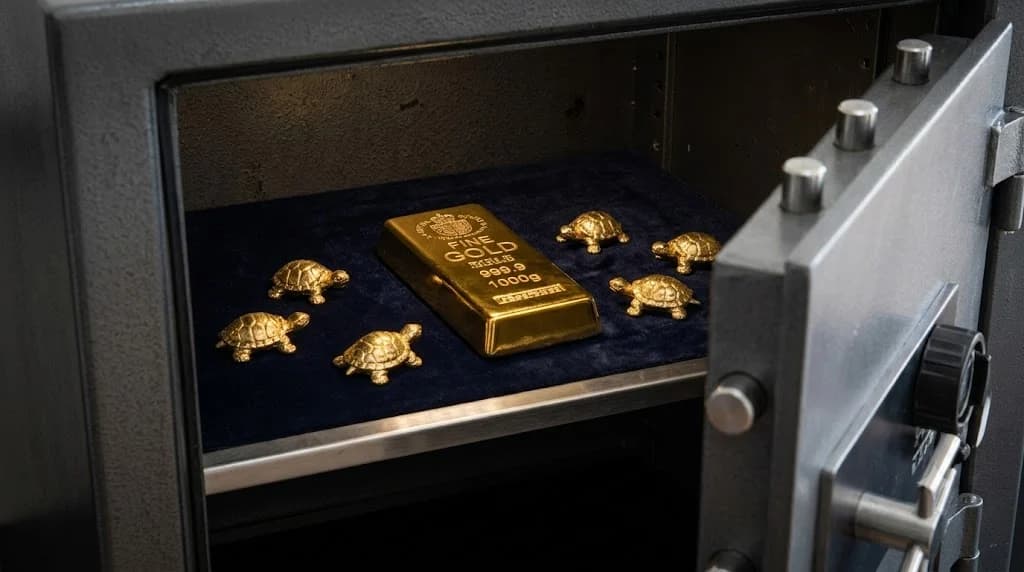
According to gold prices from the Korea Gold Exchange on October 22, 2026, pure gold (24K, 3.75g) was quoted at 772,000 won for buying and 660,000 won for selling. Both the buy and sell prices remained flat with a 0% change from the previous day. The 18K gold price stood at 485,100 won for selling and the 14K gold price at 376,200 won for selling, each recording a 0% change from the previous day.
In contrast, platinum and silver showed weakness. Platinum (3.75g) fell 7,000 won (-2.34%) from the previous day to 299,000 won for buying, and dropped 6,000 won (-2.48%) to 242,000 won for selling. Silver (3.75g) declined 80 won (-0.78%) to 10,280 won for buying, and fell 70 won (-0.82%) to 8,550 won for selling.
■ All Three Major NY Stock Indices Rise, Attention Focuses on Gold Price Movements
All three major indices of the U.S. New York stock market rose simultaneously, drawing attention to the price movement of gold, a representative safe-haven asset. On October 21 (local time), the Dow Jones Industrial Average closed at 52,856.09, up 360.21 points (0.69%) from the previous trading session. The S&P 500 index finished at 7,757.17, up 44.60 points (0.58%), approaching again the record high set earlier this month. The Nasdaq Composite Index rose 278.04 points (1.05%) to 26,702.86, posting the highest gain among the three major indices and showing strength centered on technology stocks.
Stock market gains are an important observation point for the gold market. Since gold's investment performance is determined by price changes in the asset itself rather than by generating returns through corporate profits or dividends, investors must consider not only the direction of the stock market but also interest rates, the dollar's value, inflation outlook, and international developments.
■ Rising Stock Prices Do Not Necessarily Mean Falling Gold Prices
Generally, when investors' appetite for risk assets strengthens, demand for safe-haven assets can relatively weaken. However, rising stock prices do not necessarily lead to falling gold prices. Stocks and gold can rise simultaneously, and since the factors moving the two assets' prices differ, it is difficult to interpret their relationship as a simple inverse one.
In particular, U.S. Treasury yields and dollar movements are key variables for gold prices. Gold pays no interest or dividends, so its relative holding appeal may diminish when interest rates rise, while its opportunity cost of holding may decrease when rates fall. As international gold prices are mainly denominated in dollars, a stronger dollar increases the burden of purchasing gold for investors in other currency zones, while a weaker dollar supports gold demand. However, these relationships also vary depending on market conditions.
■ The Value of Gold from an Asset Diversification Perspective
Another value of gold lies in its function as a diversifier. While stocks react sensitively to corporate performance and growth prospects, gold is used as a means of responding to financial market instability or currency value changes. It should be approached not merely from the perspective of potential price appreciation, but from the viewpoint of combining assets exposed to different risks.
Notable in this New York stock market rally is that the S&P 500 index approached its previous record high. The higher a stock index is, the more important it becomes to evaluate not only the possibility of further gains but also the economic conditions supporting current price levels. However, proximity to a record high alone cannot be taken as evidence of increased market risk, nor can a stock market rally alone be considered proof that gold's safe-haven function has weakened.
■ Won-Dollar Exchange Rate Variable and the Need for Comprehensive Judgment
For domestic investors, the won-dollar exchange rate adds another variable. Even if international gold prices remain unchanged, a depreciation of the won can raise gold prices converted into won, and conversely, even if international gold prices rise, a stronger won can limit the perceived increase.
Ultimately, judging the direction of gold prices requires a comprehensive look at U.S. Treasury yields, the dollar's value, and exchange rate movements alongside the U.S. stock market rally. This simultaneous rise in the New York stock market merely demonstrates strength in risk asset markets and does not directly prove a rise or fall in gold prices. As actual international gold prices and change rates have not been provided, the direction of gold prices on this day cannot be determined. The value of gold does not disappear when stock markets rise or appear only when they fall; rather, its ability to diversify risk across different market environments is a key criterion for viewing gold. This is why attention to the gold market should continue even as the New York stock market approaches record highs.
[This article is intended to provide information for investment reference purposes and does not recommend the purchase or sale of gold. Investment decisions and the responsibility for them rest with the investor.]
CBC Globe publishes verified stories with editorial review, source checks, and tenant-specific publication standards.
Related Articles

Bigtech Shares Surge Over 20%, Breaching 3,750 Won Level... Attention Focuses on Defense Stocks After Kim Yo-jong's Remarks
Green Cross Q3 Operating Profit Expected to Rise 39.7%... Mirae Asset Securities Maintains 'Buy' Rating and Target Price of 180,000 Won
SKAI and AgentAI Both Hit Upper Limit, but Stock Market Vitality Remains Limited... Only 2 Limit-Up Stocks as Volatile Market Conditions Persist