
Exchange Rate Volatility Hits 15-Year High... Concerns Grow Over Exporters' 'Exchange Rate Losses' Amid Recent Sharp Decline
This year, the monthly average fluctuation range of the won-dollar exchange rate reached 47.0 won, marking the highest level in 15 years since the 2009 global financial crisis. **Highest Volatility in 15 Years... Daily Fluctuation Nears 8.2 Won** Excluding crisis periods that exhibited excessive vo
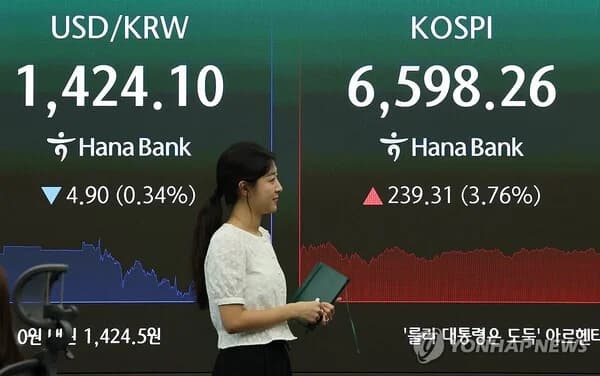
This year, the monthly average fluctuation range of the won-dollar exchange rate reached 47.0 won, marking the highest level in 15 years since the 2009 global financial crisis.
Highest Volatility in 15 Years... Daily Fluctuation Nears 8.2 Won Excluding crisis periods that exhibited excessive volatility, instances where the monthly average fluctuation range exceeded 40 won were rare. Only four occurrences were recorded: the 1997 foreign exchange crisis (72.2 won), 1998 (97.6 won), 2008 (68.3 won), and 2009 (61.2 won). The daily fluctuation range also reached 8.2 won, the highest level since 2009 (9.4 won).
This year, the exchange rate followed a dramatic roller-coaster trajectory. In March, immediately following the outbreak of the Middle East war, the exchange rate surged by 90.4 won, but in April, it dropped by 46.8 won due to expectations for U.S.-Iran negotiations, among other factors. Subsequently, in May and June, the rate rose by 24.6 won and 41.5 won, respectively, as foreign net selling of stocks coincided with Middle East tensions. However, in July, the trend reversed with a sharp decline of 125.4 won.
Recent 139.7-Won Plummet... Falls 5.6 Won Per Day on Average, Entering the 1,400-Won Range Recently, won-buying momentum strengthened as the inflow of funds following the listing of SK Hynix American Depositary Receipts (ADRs), dollar-selling by export companies, and market interventions by U.S. and Japanese foreign exchange authorities converged.
With these changes, the exchange rate climbed to 1,555.8 won on the 2nd of last month (based on weekly closing price) before falling 139.7 won over 25 trading days to reach 1,416.1 won on the 7th. This equates to an average daily drop of 5.6 won, a pace of decline more than double that seen during the April-June period of last year (an average of 2.5 won per day). At 6:00 a.m. on the 8th, trading closed at 1,409.5 won, with the intraday low (1,407.3 won) marking the lowest level since October 2 of last year (1,399.5 won).
Concerns Over Exporters' Exchange Rate Losses... "Recovery to the 1,420-Won Range Is the Key Going Forward" As the exchange rate falls rapidly, export companies are facing concerns over exchange rate losses and deteriorating profitability. Lee Min-hyuk, an economist at KB Kookmin Bank, pointed out that companies that delayed dollar-selling timing in anticipation of a further rise in the exchange rate, or import companies that purchased forward exchange contracts, could suffer exchange rate losses.
Min Kyung-won, a researcher at Woori Bank, projected, "In the short term, whether the rate recovers to the 1,420-won range will be an important benchmark for the future exchange rate trend," adding, "Next week, settlement demand from import companies could emerge, providing support at the current level."
Opinions were also raised that future exchange rate movements could be influenced by the potential outflow of retail investors investing overseas and foreign funds due to expanded stock market volatility, the weakening effect of coordination between U.S. and Japanese foreign exchange authorities, and the resumption of yen weakness. The market expects the 1,400-won level to act as the first line of support, and if conditions such as a U.S. Federal Reserve interest rate freeze and stable international oil prices are met, the possibility of entering the 1,300-won range is also being discussed.
CBC Globe publishes verified stories with editorial review, source checks, and tenant-specific publication standards.
Related Articles

Gyeonggi Governor Choo Mi-ae: "Semiconductor Companies Must Strengthen Self-Rescue Measures to Minimize Process Water Discharge and Reduce Environmental Impact"

South Korea Men's Volleyball Defeats Japan → Wins Second Consecutive East Asian Championship Title... Fourth Overall Championship

Capable of Working at 100m Heights... Large Aerial Work Platforms Over 40t Newly Designated as Special Construction Machinery