
Gold Prices for July 29
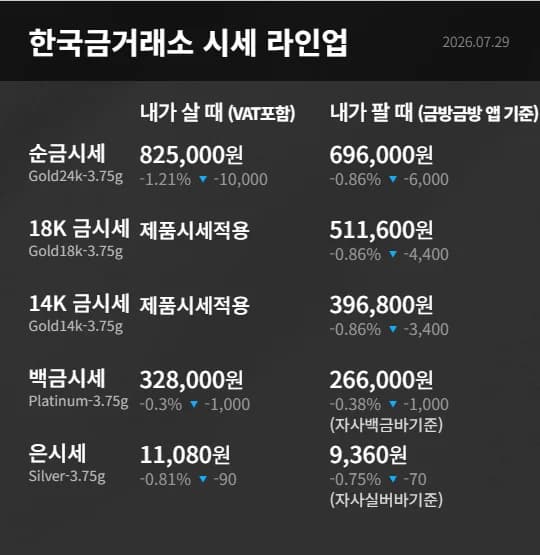
**[July 29, 2026 Gold, Silver, and Platinum Prices]** As of July 29, 2026, according to the Korea Gold Exchange, pure gold (24K, 3.75g) was priced at 825,000 wo
[July 29, 2026 Gold, Silver, and Platinum Prices]
As of July 29, 2026, according to the Korea Gold Exchange, pure gold (24K, 3.75g) was priced at 825,000 won for buying and 696,000 won for selling. The buying price fell by 1.21% (10,000 won) compared to the previous trading day, and the selling price also dropped by 0.86% (6,000 won).
| Purity | Buying | Selling | Change from Previous Day | |------|-----------|-----------|---------| | 24K (3.75g) | 825,000 won | 696,000 won | Buying ▼1.21% / Selling ▼0.86% | | 18K (3.75g) | - | 511,600 won | ▼0.86% (4,400 won) | | 14K (3.75g) | - | 396,800 won | ▼0.86% (3,400 won) |
Platinum (3.75g) was recorded at 328,000 won for buying (down 0.3%, 1,000 won from the previous day) and 266,000 won for selling (down 0.38%, 1,000 won). Silver (3.75g) was priced at 11,080 won for buying (down 0.81%, 90 won from the previous day) and 9,360 won for selling (down 0.75%, 70 won).
---
International Gold Prices Fall Ahead of FOMC... $4,015.60 per Ounce
International gold prices fell ahead of the U.S. Federal Open Market Committee's (FOMC) decision on the benchmark interest rate. As of July 29, the international spot gold price stood at $4,015.60 per ounce, down $23.10 (0.57%) from the previous day. Although it maintained the $4,000 per ounce level, growing caution ahead of the FOMC prevented active buying from flowing in.
On the same day, the New York stock market showed clear mixed results across sectors. The Dow Jones Industrial Average closed up 537.24 points (1.03%) at 52,747.32, and the S&P 500 index also rose 0.2% to 7,428.78. In contrast, the Nasdaq Composite Index closed down 0.2% at 24,876.91. Strong earnings from large-cap blue-chip stocks, including Coca-Cola, lifted the Dow, while a correction in artificial intelligence (AI) and semiconductor-related stocks weighed on the Nasdaq.
---
Why a Strong Dollar Pressures Gold Prices
Generally, when stock market volatility increases, funds are highly likely to move to gold, a safe-haven asset. However, in this market, demand concentrated more in the dollar than in gold. When the value of the dollar rises, gold prices denominated in dollars become relatively more expensive for investors outside the United States, which can shrink gold demand.
The Dollar Index, which measures the value of the dollar against six major currencies, recently rose to the mid-101 range, the highest level in a month. It moved near a recent high of around 101.80, acting as a direct downward pressure on the gold market. The expectation that the FOMC could send hawkish signals due to inflation concerns, even if it freezes rates, supported the dollar.
Gold is a non-yielding asset that does not pay interest or dividends. As benchmark interest rates and Treasury yields remain high, interest income from holding cash and bonds increases, and the opportunity cost of holding gold also rises. Therefore, the gold market reacts sensitively not only to actual interest rate decisions but also to remarks by Federal Reserve (Fed) officials and changes in future interest rate outlooks.
---
July FOMC: 70% Chance of a Freeze... Chairman Kevin Warsh's Remarks Are the Key Variable
The Fed is holding its July FOMC meeting over two days, from July 28 to 29. In its previous meeting, the Fed maintained the target range for the federal funds rate at 3.50–3.75% per annum, and the July 28–29 schedule was specified in the minutes of the June meeting.
The interest rate futures market is pricing in about a 70% probability of a rate freeze at this meeting. Market focus is centered less on a simple freeze and more on what expressions Fed Chairman Kevin Warsh will use regarding inflation and the future interest rate path during his press conference. Even if a rate freeze is announced, remarks leaving open the possibility of additional hikes could cause the dollar and short-term Treasury yields to rise again, putting pressure on gold prices. Conversely, if he emphasizes falling energy prices or an economic slowdown and shows a cautious attitude toward further tightening, the strong dollar could ease and the decline in gold prices could narrow. The possibility of a rate hike at the September meeting is also largely priced in, so the gold market is reacting more sensitively to the policy path after September than to this freeze itself.
---
Treasury Yields Fall, Dollar Strengthens... Growing Wait-and-See Attitude in the Gold Market
U.S. Treasury yields fell on this day due to a drop in international oil prices and an influx of bond buying. The yield on the 10-year Treasury note fell to about 4.604%, and the yield on the 2-year note, which is sensitive to monetary policy outlooks, dropped to about 4.275%. Generally, falling Treasury yields are favorable for gold prices, but on this day, the strong dollar and FOMC uncertainty were reflected more heavily, limiting the effect of the yield drop. The fact that the dollar and Treasury yields moved in different directions also fueled a wait-and-see attitude in the gold market.
The recent drop in international oil prices is also having a complex effect on gold prices. A decline in oil prices can alleviate concerns about energy-driven inflation, which could reduce the Fed's pressure to raise rates, potentially becoming a positive factor for gold in the medium to long term. However, gold prices underwent a sharp correction after peaking earlier this year. Military conflicts in the Middle East and rising energy prices stimulated inflation fears, and as the market began to price in the possibility of rate freezes or additional hikes rather than rate cuts by the Fed, gold's investment appeal diminished. Even though gold is classified as a traditional inflation-defense asset, in the actual market, nominal interest rates, real interest rates, and the value of the dollar simultaneously dictate its price.
---
Impact of U.S. Big Tech Earnings and Semiconductor Correction on Gold Prices
This week's earnings announcements from major U.S. Big Tech companies are also relevant to gold prices. Starting with Microsoft and Meta Platforms, earnings from major technology companies such as Apple and Amazon will follow. If companies expand capital investment in AI data centers, semiconductors, and cloud infrastructure, investment sentiment in tech stocks could recover, which may reduce demand for safe-haven assets. Conversely, if increased AI investment costs lead to deteriorating profitability or future outlooks fall short of market expectations, volatility in tech stocks could expand. In such a scenario, the key question is whether risk-off funds will move to the dollar, Treasury bonds, or gold. Even in recent risk-off situations, the dollar has shown stronger momentum than gold, making it difficult to expect gold prices to rise solely based on a Nasdaq decline.
The correction in the semiconductor sector is also a variable the gold market is watching closely. Companies like AMD, Micron, and Teradyne were affected by weakness in Asian tech stocks, high valuation burdens, and profit-taking. Whether the correction in AI-related stocks remains a temporary rotational sell-off or expands into broader risk aversion for growth stocks will determine the scale of funds flowing into gold.
---
ETF Fund Outflows vs. Central Bank Purchases... Polarizing Gold Demand
The movement of Gold Exchange-Traded Funds (ETFs), which indicate the flow of gold investment funds, has weakened recently. According to the World Gold Council, $8.9 billion in funds flowed out of global physically backed gold ETFs in June alone. Holdings were reported at 4,047 tons, a decrease of 74 tons over the month, with net outflows occurring across all regions, particularly in North America. This suggests that institutional and financial market investors temporarily reduced their gold allocations and shifted funds to other assets such as cash, bonds, and equities.
However, for the first half of the year as a whole, global gold ETFs saw a net inflow of approximately $8 billion, with about $12 billion flowing into the Asian region alone, showing a differentiated trend by region. It is difficult to conclude that long-term gold investment demand has disappeared based solely on the large-scale outflows in the month of June.
Steady gold purchases by central banks are also cited as a long-term bottom support factor. According to World Gold Council data, gold demand from central banks and public institutions worldwide in the first quarter of this year was about 243.7 tons, up 3% year-on-year and 17% from the previous quarter. Poland and Uzbekistan were the major buyers. In a World Gold Council survey of central banks, 89% of respondents expected global central bank gold holdings to increase over the next 12 months, and 45% of central banks indicated plans to expand their own gold holdings, a record high.
[※ This article is for investment reference purposes only, and the responsibility for investment decisions lies with the investor.]
CBC Globe publishes verified stories with editorial review, source checks, and tenant-specific publication standards.
Related Articles
![[Breaking] Hanwha Ocean Plunges, Triggering VI Three Times... Dark Clouds Over KOSPI and KOSDAQ](/_next/image?url=https%3A%2F%2Fmedia.cbcglobe.com%2Ftenants%2Fcbc00000-0000-4000-8000-000000000001%2Fmedia%2Fcbc%2F2026%2F07%2F587388%2F11650f107b42ef32%2Fvariants%2Fhero.webp&w=1920&q=75)
[Breaking] Hanwha Ocean Plunges, Triggering VI Three Times... Dark Clouds Over KOSPI and KOSDAQ
KOSDAQ Large-Cap Stocks Plunge…Jusung Engineering and Wonik IPS Fall Nearly 10%
![[Breaking] SK Hynix Plunges 9%, Triggering VI... Falls Below 1.4 Million Won During Session, KOSPI and KOSDAQ Both Weaken](/_next/image?url=https%3A%2F%2Fmedia.cbcglobe.com%2Ftenants%2Fcbc00000-0000-4000-8000-000000000001%2Fmedia%2Fcbc%2F2026%2F07%2F588754%2F5f28c33aa48a73e6%2Fvariants%2Fhero.webp&w=1920&q=75)
[Breaking] SK Hynix Plunges 9%, Triggering VI... Falls Below 1.4 Million Won During Session, KOSPI and KOSDAQ Both Weaken