Presidential Office: "Real Estate Tax Reform Focused on Protecting Single-Homeowners and Fair Taxation... Closely Monitoring Stock Market Volatility from Single-Stock Leveraged ETFs"
The Presidential Office stated on the 6th that the core of the recently announced real estate tax reform plan lies in fair taxation and enhancing equity. In an
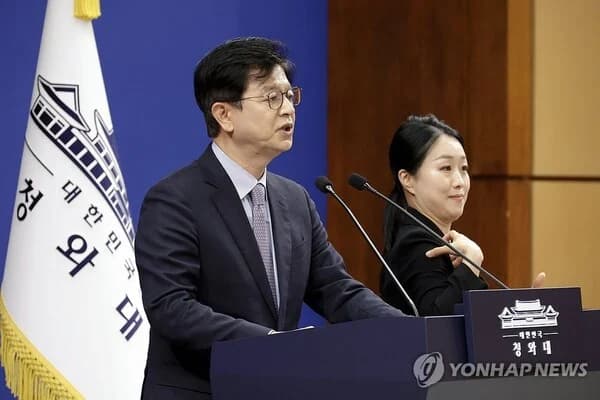
The Presidential Office stated on the 6th that the core of the recently announced real estate tax reform plan lies in fair taxation and enhancing equity. In an interview with CBS Radio's "Park Sung-tae's News Show," Senior Secretary for Public Communication Seong Ki-hong explained that this real estate tax reform is not about stabilizing housing prices or short-term market responses, but rather focuses on protecting single-homeowners and normalizing the tax burden on high-value, non-resident, and multi-homeowners.
The government is preparing various measures to expand housing supply and rationalize housing finance, and plans to release policies, including supply measures, as soon as possible. Regarding the jeonse (lease deposit) rental market, it stated that it will continue to pursue practical measures such as expanding public rental housing and easing the housing cost burden on youth and non-homeowners. In response to criticism that jeonse measures are insufficient, Seong emphasized that it is difficult for all property tax increases to be passed on to jeonse prices, and that supply and demand must be considered comprehensively.
Regarding the slow pace of supplying major sites such as the Gwacheon Racecourse and Taereung Golf Course, he explained that the president is personally overseeing administrative and regulatory issues, calling for solutions that break away from past practices. He added that the government is approaching housing supply expansion with extraordinary resolve and is engaging in a speed battle. Regarding the meeting between Policy Chief Kim Yong-beom and Seoul Mayor Oh Se-hoon the previous day, Seong noted that active cooperation between the central government and local governments is important to resolve supply issues, and revealed plans to continue close discussions with local governments to coordinate differences.
Regarding the recent introduction of single-stock leveraged exchange-traded funds (ETFs) and the raising of responsibility for Policy Chief Kim Yong-beom, the Presidential Office took the position that it is more important to carefully assess market conditions and focus on preparing practical measures. Seong stated that not only the policy chief but all officials at the Presidential Office are meticulously reviewing the causes of and countermeasures to stock market volatility, and are considering additional measures if necessary. He added that the Presidential Office also recognizes that single-stock leveraged ETFs are a factor increasing stock market volatility, and has already introduced supplementary measures while closely monitoring market conditions.
Regarding the recent high volatility in the stock market, Seong said that the president, like the public, is also aware of investor anxiety. He explained that the government is closely monitoring stock market trends and responding responsibly, and that the president instructed his aides to thoroughly examine the causes of stock market volatility and take swift action.
Regarding President Lee Jae-myung's remark during a Ministry of Justice and Ministry of the Interior and Safety work report that he "has not read the entire Criminal Procedure Act amendment bill," Seong clarified that the president is fully aware of the intent and key contents of the amended Criminal Procedure Act. He added that the president's remark came in the process of asking about the role of the joint investigation headquarters and his understanding of future changes to the investigation system. Seong emphasized that the amendment to the Criminal Procedure Act is a large-scale reform of the judicial system made for the first time in about 70 years, and that the future challenge is for the public prosecution office, serious crime investigation office, and police to successfully lead the investigation system without causing harm to the public. He also reaffirmed the principle that if problems arise due to the abolition of supplementary investigation rights, the government will swiftly and boldly improve the system to meet the public's expectations. Seong stated that reform does not end with a single institutional change, and expressed his commitment to quickly improving any deficiencies or flaws that are revealed.
CBC Globe publishes verified stories with editorial review, source checks, and tenant-specific publication standards.
Related Articles

Doosan Enerbility Holds Firm Despite KOSPI's 4.58% Plunge... Stock Outlook for the 7th

Big Tech Companies Boost Cash Generation Capacity... SanDisk, Micron, and Alphabet Strengthen Shareholder Returns

Earned Income Tax Credit Income Thresholds and Payouts Simultaneously Increased... 730,000 More Households to Become Eligible Starting Next Year