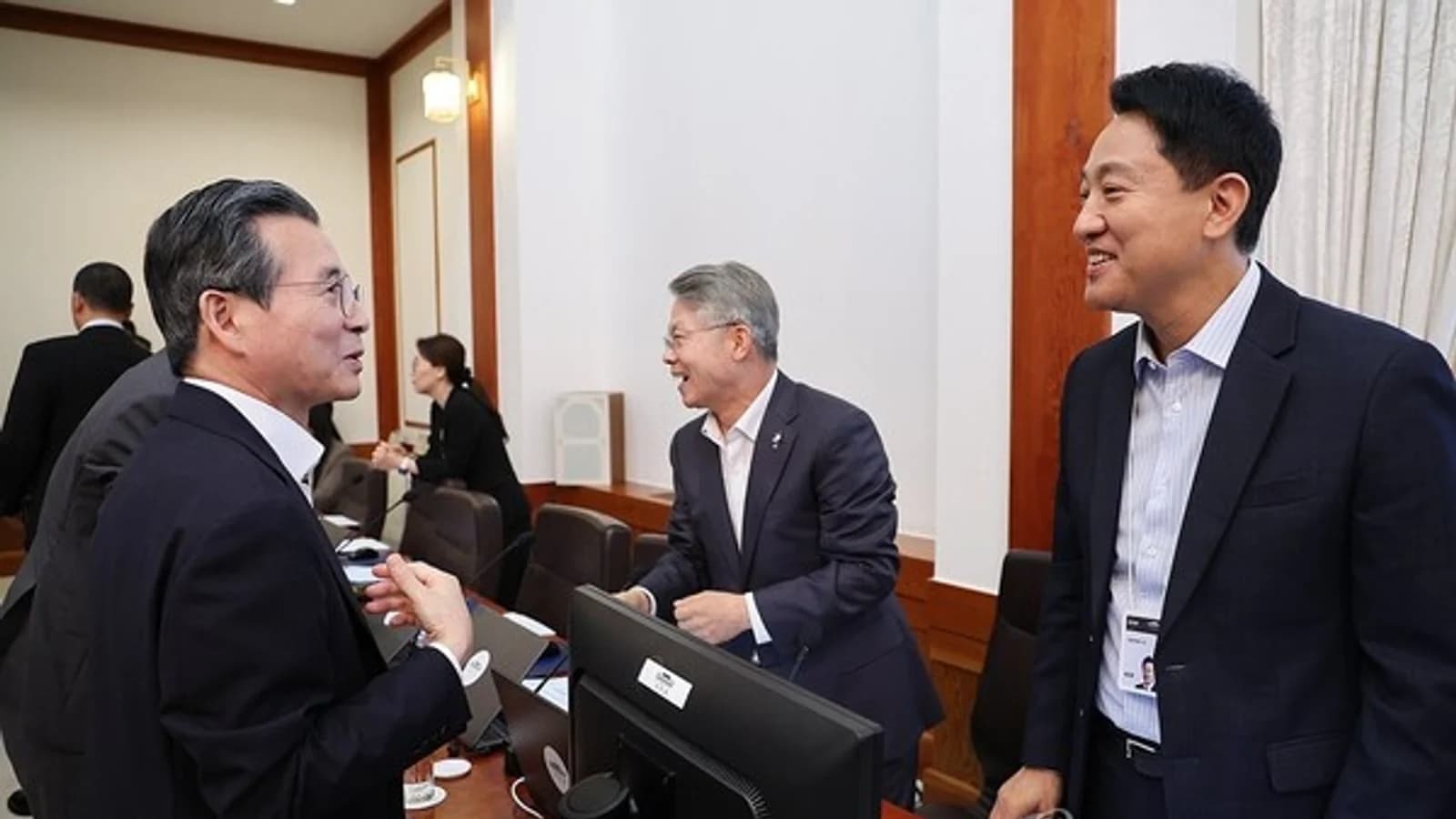
Democratic Party Leadership Race: Kim Min-seok Takes Lead... Final Results on 17th as Honam and Capital Region Emerge as 'Decisive Battlegrounds'
The Democratic Party of Korea's August 17 national convention leadership race has entered its final sprint. Following the results of four regional tour primaries, candidate Kim Min-seok has overtaken candidate Jeong Cheong-rae by a narrow margin to claim first place. The outlook is expected to be de
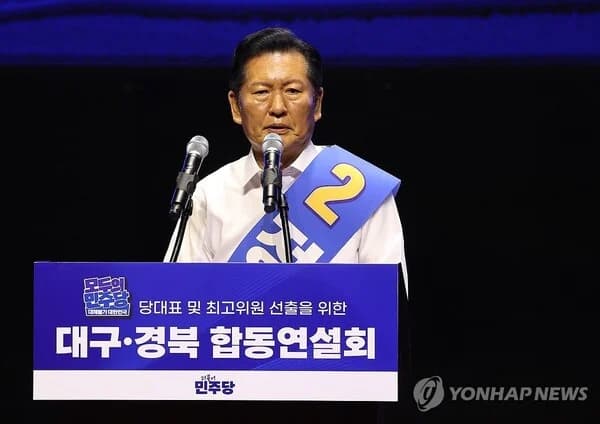
The Democratic Party of Korea's August 17 national convention leadership race has entered its final sprint. Following the results of four regional tour primaries, candidate Kim Min-seok has overtaken candidate Jeong Cheong-rae by a narrow margin to claim first place. The outlook is expected to be determined by the voting results in the Honam and capital region (Seoul and Gyeonggi), where approximately 70% of all party members with voting rights are concentrated. The final party leadership conclusion will be announced on the 17th.
Four-Region Primary Results: Kim Min-seok Overtakes to Take First Place Following the conclusion of four regional tour primaries — Chungcheong, Busan-Ulsan-Gyeongnam (PK), Jeju-Incheon, and Gangwon-Daegu-Gyeongbuk (TK) — candidate Kim Min-seok is leading with a cumulative 95,821 votes (46.01%). Candidate Jeong Cheong-rae is closely behind with 92,735 votes (44.53%), while candidate Song Young-gil has secured 19,715 votes (9.47%). However, the 5% weighted bonus applied to the Gyeongnam-Daegu-Gyeongbuk region has not yet been reflected in the final tally.
In the combined first week of primaries (Chungcheong and PK), candidate Jeong led by 0.99 percentage points. However, in the second week, candidate Kim won consecutively in Jeju-Incheon (47.75%) and Gangwon-TK (48.54%), surpassing Jeong (42.08% and 44.4%, respectively) to reverse the rankings. The current cumulative vote gap between the two leading candidates is only 3,086 votes (1.48 percentage points), making it an ultra-close race where the outcome could be overturned at any time depending on the remaining votes.
Decisive Battleground to Determine Outcome: 510,000 Honam vs. 590,000 Capital Region Voters The Honam region (approximately 510,000 members) and Seoul-Gyeonggi (approximately 590,000 members), which together account for about 70% of all party members with voting rights, are identified as the biggest battlegrounds. The Democratic Party will conduct Honam region member voting from the 11th to the 14th, and Seoul-Gyeonggi voting from the 12th to the 15th, both online and via ARS. To coincide with the conclusion of the schedule, joint campaign rallies will be held in Jeonnam, Gwangju, and Jeonbuk on the 15th, and in Gyeonggi and Seoul on the 16th, after which results will be announced.
In particular, Honam, which is home to one-third of all party members with voting rights, is traditionally a region known for active strategic voting. Additionally, many members in the capital region are of Honam origin, suggesting that Honam's voting tendencies could influence the capital region's results as well. However, some observers note that the overlapping voting schedules in both regions may limit the bandwagon effect.
Three Candidates Vie for Late-Stage Votes Each candidate has launched an intensive campaign to capture the remaining regional votes. Candidate Kim Min-seok pledged to establish a 'Mega Regional Growth Special Committee,' promoting a strategy to link the government's three mega-projects with Honam's development. On the 10th, he focused on courting capital region voters through morning greetings at Sillim Station in Seoul, a meeting with Gyeonggi women lawmakers, and discussions with metropolitan professional organizations.
Candidate Jeong Cheong-rae emphasized the unhindered promotion of key government projects, referring to Honam members as 'the mothers of the Democratic Party' and actively appealing for their support. He recently increased his references to Honam members at the Gangwon-TK joint rally, and on the 10th, he completed a schedule of events in Jeonbuk, including a meeting with Jeonbuk public service workers and an agricultural policy discussion in Wanju.
Candidate Song Young-gil emphasized that over 70% of the total votes remain, fueling his determination to reverse the standings. Evaluated as having strong organizational power in Honam as a native of Goheung, Jeonnam-Gwangju, he concentrated his campaign on the Honam region on the 10th, visiting the Yeonggwang Hanbit Nuclear Power Headquarters and holding a rally in Jeonju.
Preferential Voting System Introduced... 'Song Young-gil Supporters' Second Choice' as Late-Stage Variable The final leadership results will be announced on the 17th, combining party member and delegate voting (70%) with general public opinion polls (30%). The introduction of a preferential voting system at this convention has drawn particular attention. If no candidate secures a majority, the second-choice votes of those who selected the third-place candidate as their first choice will be distributed between the top two candidates. Therefore, the second-choice selection of Song Young-gil's supporters could serve as a key variable in determining the final outcome.
Supreme Council Race: Pro-Lee Jae-myung vs. Pro-Jeong Cheong-rae Faction Clash Meanwhile, in the Supreme Council race, candidates Choi Min-hee, Park Sun-won, Han Min-su, Seo Mi-hwa, and Kim Yong have recorded the top five cumulative vote shares, securing positions for election. By faction, Park Sun-won, Seo Mi-hwa, and Kim Yong are classified as pro-Lee Jae-myung, while Choi Min-hee and Han Min-su are categorized as pro-Jeong Cheong-rae. According to Democratic Party regulations, if all five elected Supreme Council members are male, a quota system applies, replacing the fifth-place male with the female candidate who received the most votes.
CBC Globe publishes verified stories with editorial review, source checks, and tenant-specific publication standards.
Related Articles

Samsung Electronics Partners with Korail to Officially Launch 'Samsung Wallet' Mobile Ticket Service
Rep. Hwang Hee Apologizes for 'Bus House' Proposal... "I Have Disappointed Young People"
Alexander-Arnold Likely to Stay at Real Madrid... "Manager Mourinho Trusts Him as Tactical Core"